
Creator Whitelisting Done Right: Brand Safety + Scale
Scale creator partnerships without risking your brand. Learn how to do whitelisting right for safer ads, better reach, and control.

· 18 min read
Most marketers love the idea of creator whitelisting, as it offers strong content, real voices, and performance-ready handles. What’s not to like?
But here’s the thing: whitelisting isn’t just boosting a post. It is a full-on paid social lever, one that lets you run ads directly from a creator’s handle using your own targeting and budget.
When done right, it combines authenticity with performance. However, if done incorrectly, it can lead to brand safety risks that quietly undermine ROI.
And those risks are growing. In the U.S. alone, offensive content next to digital ads jumped 28% in 2024, reaching its highest point in three years, according to the 2025 IAS Media Quality Report.
This means one bad adjacency (or one overlooked creator), and your campaign’s ROI can take a hit fast.
This guide breaks down how to run creator whitelisting with real control. We’ll show you what’s changed, where the brand safety gaps show up, and how to scale performance without crossing the line into chaos.
Let’s get into it.
P.S.: At 9AM, brand safety leads the whitelisting process. We test creators with controlled spend, set clear permissions upfront, and only scale once the creator's content proves safe and performs under real delivery conditions.
TL;DR
Not enough time to read it all? Here’s what you need to know:
Creator whitelisting lets brands run ads through influencer handles with full control over spend, targeting, and creative.
It works: Meta reports 19% lower CPAs and 13% higher CTRs with partnership ads.
But the risks are real. Inappropriate adjacencies and poor creator vetting can trigger brand damage and kill performance.
In the U.S., offensive content in digital ad environments rose 28% in 2024. Brand safety matters more than ever.
Strong whitelisting programs balance performance and protection: with vetting systems, clear permissions, creative guardrails, and audience control.
Most teams under-vet creators. Only 21.8% of brands believe their agencies have a defined vetting process, while 96.6% want documentation and rarely get it.
Done right, whitelisting lets you scale from one creator to fifty without compromising brand integrity or paid results.
What Is Creator Whitelisting and Why Does It Matter
Creator whitelisting means getting permission from a creator to run ads from their social handle.
But unlike organic influencer posts, these are paid ads that the brand fully controls: targeting, budget, creative, and A/B testing all happen behind the scenes.
It’s not the same as boosting a post. Boosted content is limited. You’re taking an existing organic post and putting spend behind it.
With whitelisting, you can build net-new ads and run them as if the creator posted them natively. That means more flexibility, more control, and a better fit for performance teams.
So why does this matter?
Because it combines trust and reach in a way few other paid formats can. Your ad shows up under a creator’s name (someone their audience already knows and follows), but it behaves like a performance campaign. You get creator relatability and media efficiency.
And it works across platforms: Meta (Facebook/Instagram/Threads), TikTok, YouTube, and even LinkedIn.
But here’s the catch: with that visibility comes responsibility. Once your brand appears under a creator’s handle, their reputation becomes yours, at least in the eyes of your audience.
Whitelisting only works if the creator’s social media handle has real trust. If the audience doesn’t recognize the content creator as credible, the ad reads like paid media immediately.
That’s why brand safety becomes a core pillar of any serious whitelisting program. Because it is a performance tool that requires real governance.
Pro Tip: Influencer whitelisting works best when it’s treated like a digital marketing campaign and not a one-off creator post. That mindset shift changes how you brief, test, and measure outcomes.
Real-World Example: Miro’s Creator Whitelisting Campaign Led by 9AM
Let’s look at how this plays out in practice.
In a campaign we ran for Miro, we partnered with David Pereira, a product leadership expert who built a strong audience around better roadmap thinking.
Instead of just sponsoring his post, we took it further: we whitelisted his content and ran it as a paid campaign.
Here’s the difference that made:
The post came directly from David’s handle, not Miro’s.
We controlled targeting and spend through the backend.
The ad felt native to his audience, but optimized for performance.
His message hit a common pain point: teams stuck in feature factories, shipping roadmaps with no real business value.
His Now–Next–Later framework offered a clear solution, and we linked the CTA to a Miroverse template that users could grab instantly.
Because we had ad permissions, we could test formats, adjust spend, and refine targeting without asking David to repost or change anything.
The result is strong engagement, measurable conversions, and zero risk of misalignment.
This kind of campaign works because it feels like him, but performs like us. That balance is what good whitelisting looks like.
Whitelisting Ads vs Partnership Ads
Whitelisting ads gives you permission to run ads from a creator’s handle using the brand’s own ad account, full targeting control, custom budgets, and ongoing optimization, just like any performance campaign.
Partnership ads (branded content ads) promote a creator’s post that is tagged as a paid partnership, but the ad delivery, targeting flexibility, and scaling options are more limited and usually tied to the creator’s original post settings.
The main difference is that whitelisting ads are built for performance control and scale, while partnership ads are designed for disclosure and visibility with limited optimization power.
The Brand Safety Problem in Influencer Marketing
Creator content is powerful, but not always predictable. And that’s exactly where most influencer marketing programs run into trouble: brand safety.
When you amplify a creator’s voice through whitelisting, you’re not just co-signing their content; you’re making it part of your brand’s paid message. And that’s a big deal when things go wrong.
Brand Safety Risks When Running Creator Ads
Creator whitelisting gives brands control over spend and performance, but not automatically over risk. In our daily practice, we’ve learned that without clear safeguards, even high-performing creator ads can introduce brand safety blind spots.
Here’s what can go sideways fast:
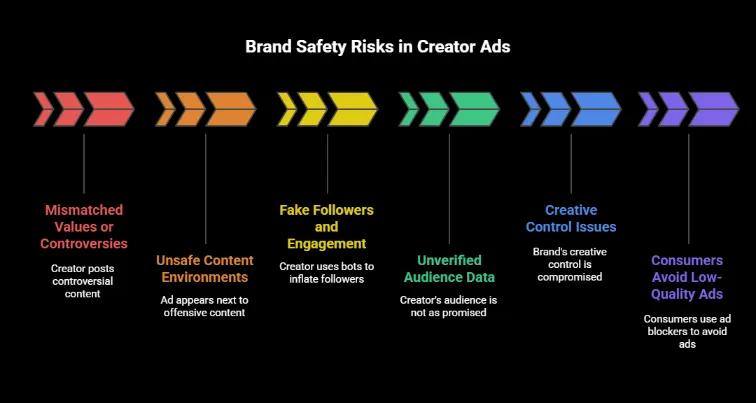
Mismatched values or creator controversies: We’ve seen cases where a creator posts something political, insensitive, or off-brand after an ad goes live, which leaves brand messaging visibly attached to a narrative the brand never approved.
Unsafe or low-quality content environments: Your whitelisted ad ends up next to offensive, violent, or misleading content.
Fake followers, engagement pods, or bot behavior: You invest in reach that’s not even real. And with bot fraud up 106% in the U.S. according to the DoubleVerify 2025 report, the risks are growing fast, especially in mobile video.
Consumers are actively avoiding low-quality ad experiences: The DoubleVerify 2025 report also stated that 41% of North American respondents reported using ad blockers, which means creative and placement quality directly affect reach and efficiency.
Unverified audience data: Creators may promise “your ideal customer,” but their following could be mostly inactive, international, or irrelevant.
Creative control issues: Without the right permissions and guardrails, your brand ends up diluted or misrepresented, even unintentionally.
And here’s the twist: even if the creator behaves perfectly, the platform environment can still put your ad in the wrong context.
Therefore, we suggest monitoring engagement rate quality rather than just the number. Sudden spikes in engagement rates can signal low-quality attention that won’t translate once you turn the content into social media ads.
Platforms like TikTok and Meta are constantly evolving how ad adjacency works, and not always in ways you can fully control unless you're proactive.
Key Insight: The same 2025 IAS Media Quality Report that we shared above showed that campaigns that run without fraud protection hit 10.9% fraud by the end of 2024, while protected campaigns stayed at 0.7%.
How Poor Brand Safety Impacts Performance
Brand safety is mostly treated as a compliance issue, but we have learned that it functions more like a performance variable. When safety slips, performance follows.
Poor brand safety undermines campaign results in several measurable ways:
Lower trust = lower conversions: When trust drops, conversions follow. Ads placed in the wrong environment trigger doubt. That pause is enough for users to check out or keep scrolling.
Higher CPMs and lower ad relevance: Platforms deprioritize ads with weak engagement or flagged content environments. That drives up costs fast.
Wasted creator spend: You paid for authenticity, and all you got was noise or worse, backlash.
Long-term damage to brand equity: One viral screenshot of your ad next to the wrong content can outlive the campaign itself.
Real customer loss: 51% of users say they’d stop using a brand that advertises near inappropriate content.
Brand risk is shifting fast: The global share of offensive content rose 72% year over year in 2024, which raises the bar for brand suitability controls.
All of these point to one thing: if your whitelisting program doesn’t have built-in brand safety systems, you’re scaling exposure, but not impact.
What “Done Right” Looks Like: Safe + Scalable Creator Whitelisting
Brand safety and scale aren’t at odds. But without a system, they absolutely feel that way.
If you want to grow a whitelisting program beyond one or two creators (and still protect your brand), here’s what that takes:
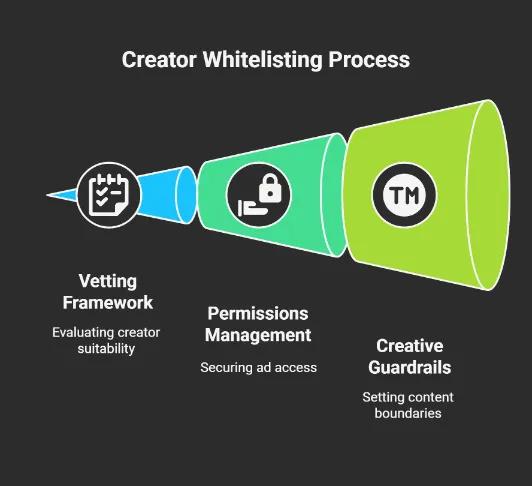
1. Build a Brand-Safe Creator Selection Framework
From our experience working with different teams, the biggest risk in creator whitelisting is selecting the wrong people to run your ads through.
That’s why your selection process needs more than “they seem on-brand.” It needs a vetting framework that catches red flags before they cost you.
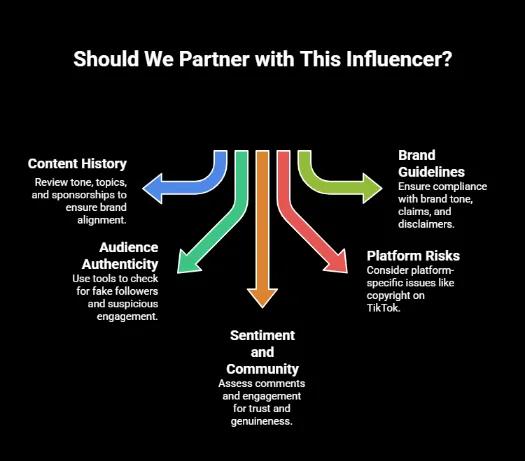
Based on what we have seen work consistently, we recommend the following creator vetting framework:
Content history: Review tone, topics, past sponsorships, and alignment with your brand values.
Audience authenticity: Use third-party tools to check for fake followers, bot spikes, or suspicious engagement patterns.
Sentiment and community behavior: Are their comments full of spam? Are followers genuinely engaging? Do they spark trust?
Platform-specific risks: For example, TikTok creators using trending sounds may run into copyright or brand safety issues if not managed carefully.
Compliance with your brand’s guidelines: Think tone, topics, claims, disclaimers, everything that would apply to an internal campaign.
Most of the time, teams skip this step because they trust the creator or assume the agency handled it.
But remember: only 25.6% of brands consistently receive vetting documentation, even though 96.6% say they want it, according to eMarketer.
2. Use First-Party Data + Permissions Correctly
Working across multiple creator programs, we have learned that getting ad permissions from a creator is where control starts. And without clear roles and access management, even well-intentioned campaigns can spiral.
Here’s how you can handle permissions the right way:
Secure access to creator handles: Always request permissions through platform-native flows like Meta’s Branded Content tools or TikTok Spark Ads. Skip the screenshots and handshake deals; this part needs structure.
Connect permissions to the right ad accounts: Make sure your media team is running campaigns from accounts with clear ownership, role-based access, and audit logs. You don’t want five creators tied to five different business managers.
Let creators stay authentic without losing oversight: Whitelisting works because it feels native. But that doesn’t mean creators should have full control over ad creative or spend. Set clear boundaries: you handle optimization; they bring the voice.
And don’t forget: platform settings evolve. Meta, for instance, now offers account-level brand safety filters and lets brands build custom blocklists with partners. That gives you more control, but only if your permissions structure supports it.
Pro Tip: In TikTok Ads Manager, treat Partnership Ad Codes like an operational checkpoint. If codes, creator licensing, or content rights aren’t clean, scaling becomes messy fast.
3. Set Creative Guardrails That Protect Brand Safety
Letting creators speak in their voice doesn’t mean handing over the mic completely. If you want content that converts and protects your brand, you need clear creative guardrails before anything goes live.
Here’s what to lock in:
Messaging dos and don'ts: Define what the creator can say and what’s off-limits. Product positioning, tone, language, and cultural references should all be covered.
Required claims and disclaimers: If your industry needs disclosures (think: health, finance, legal), make sure these are baked into every creative version, not just the first draft.
Platform-specific compliance: TikTok Ads, for example, restricts certain phrases in ads. YouTube has rules about endorsement disclosures. Stay current with platform compliance matters. We have seen campaigns paused simply because platform policies changed during delivery.
Remember that guardrails aren’t about controlling every word; they exist to keep the message consistent and aligned with your brand. They help creators stay on track without risking confusion or compliance issues.
A small misstep, like a missed disclaimer or an off-brand claim, can lead to rejected ads, lost budget, or negative attention you didn’t see coming. Setting the boundaries early protects both sides and keeps the creative process moving smoothly.
Pro Tip: Content Usage Rights are part of brand safety. If your content rights aren’t explicit, you risk running ads past the agreed window or across formats the creator didn’t approve.
Scaling Creator Whitelisting: From 1 Creator to 50+ Safely
Running a single whitelisted creator campaign is manageable. But scaling that system to dozens (or hundreds) without breaking performance or brand safety? That takes structure.
Here’s how we suggest scaling without losing control:
1. Build Modular Creative Assets
Scaling starts with creativity, and modularity is the only way to make it sustainable. You need formats that flex.
In our daily practice, we build creative libraries with swappable parts:
Hooks: Lead with curiosity or relatability that fits the platform.
Formats: Short-form, testimonials, tutorials, a mix and match.
CTAs: Tailored by audience segment or funnel stage.
This lets us adapt fast, rotate variations, and maintain brand consistency without starting from scratch every time.
You can pair that with a lightweight testing system. Instead of waiting for a full campaign cycle to “see what works,” run early reads: hook testing, CTA variants, thumbnail iterations. Rapid iterations beat long delays, especially when you’re managing multiple creators at once.
And if you're worried about volume fatigue or creative decay, keep in mind: many performance drops are about overused content. But it can be quickly restored with a modular structure.
2. Use Audience Intelligence for Safe Expansion
Once you have a few high-performing creators, the natural next step is scaling. From what we have seen, not all growth is smart growth. Sustainable expansion depends on signals rather than assumptions.
Start with lookalikes, but not just based on follower counts or interests. Build your expansion list using actual audience data from your top-performing creators, including geography, engagement behavior, and conversion signals. This helps you identify creators who target similar segments and perform under the same conditions.
It’s also important to check for audience overlap. We have learned that if two creators have similar content styles but identical followings, you’re spending twice for the same reach. That drives up frequency and CPMs without increasing scale.
Use this intel to pace your expansion. Add creators in structured waves, validate performance quickly, and only expand into new segments when you have real traction.
Safe growth is informed. And it prevents you from burning the budget just to chase volume.
Platform-Specific Brand Safety Considerations
Brand safety doesn’t look the same everywhere. Each platform has its own structure, risks, and tools. Knowing how to navigate them is necessary if you want consistent protection at scale.
Let’s see how each platform works:
Meta (Facebook, Threads & Instagram)
Meta offers a solid foundation for whitelisting, but only if you’re using all the controls available.
Use Branded Content tools to request and manage ad permissions properly.
Set up blocklists and inventory filters to keep your ads away from sensitive or low-quality content.
Moderate comments and placements through the Brand Safety Hub.
Collaborate with third-party partners for deeper measurement and risk detection.
TikTok
TikTok’s creator-driven ecosystem is powerful, but also fast-moving. Trends shift quickly, and what’s “brand safe” one week might not be the next.
Run Spark Ads using verified permissions
Use Video and Profile Feed Exclusion Lists to avoid problematic adjacencies.
Double-check music rights and stay alert to trend-driven content that could go sideways.
YouTube & Shorts
YouTube gives you more control over placements, but Shorts adds complexity with high-volume, short-form content.
Use category exclusions to filter out sensitive content types.
Set up placement controls to avoid misaligned inventory.
Find a good partner to ensure your ads land in safe environments.
LinkedIn has fewer brand safety landmines, but expectations around tone and credibility are higher, especially for B2B.
Choose creators with strong reputations and relevant expertise.
Watch for comment section dynamics that could skew perception.
Keep creative and polished content on this platform; a misstep feels more visible.
The more familiar you are with the controls each channel offers, the easier it becomes to scale whitelisted campaigns without second-guessing where your ads might land.
Mistakes That Break Brand Safety in Whitelisting (and How to Fix Them)
Even well-structured campaigns can fall apart when small gaps go unchecked. In our experience, these are the mistakes that show up most commonly, along with how to correct them before they impact performance or brand trust.
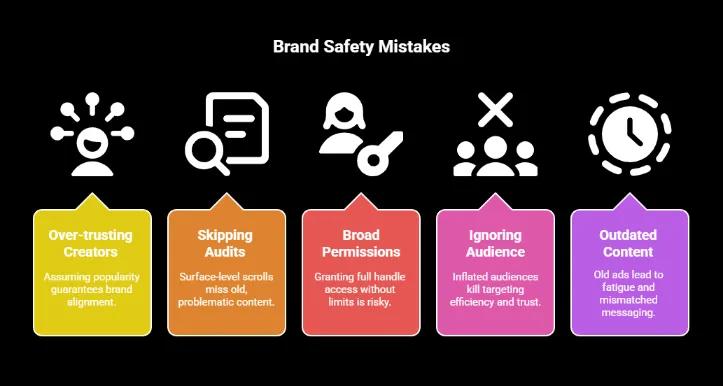
Over-trusting popular creators: It’s easy to assume a big name means safe content. But popularity doesn’t guarantee brand alignment or audience quality.
Fix: Use the same screening criteria for all creators, without shortcuts and exceptions.
Skipping background audits: A surface-level scroll isn’t enough. Creators may have years of content, and one old post can cause issues.
Fix: Include full content history and sentiment checks in your vetting flow, ideally with a second reviewer to catch what you don’t.
Giving broad permissions too quickly: Granting full handle access without limits is risky. One misclick or setting error can expose your brand.
Fix: Start with post-level or campaign-specific permissions, then expand only if the relationship proves stable.
Ignoring audience authenticity: A creator might look great on the surface but be inflated by bots or engagement pods. That kills targeting efficiency and trust.
Fix: Vet audience quality with third-party checks and look for healthy engagement patterns, not just high numbers.
Running outdated content: Even good creatives have a shelf life. Letting old whitelisted ads run for too long can lead to fatigue, mismatched messaging, or platform issues.
Fix: Set clear time limits or performance thresholds. If an asset slows down or remains idle for 60 days, it is reviewed or rotated out.
The good news is that each of these issues is fixable, but only if you catch them before they start affecting your results.
Get Creator Whitelisting Done Right with 9AM
Scaling creator campaigns sounds simple, until it isn’t. The more creators you bring in, the more variables you manage. Without the right systems, it’s easy to end up reacting instead of optimizing.
Strong whitelisting programs work because every part of the process is intentional. Creator selection, vetting, and review rhythms are treated as core parts of campaign execution. That’s what keeps performance high and brand risk low, even as you scale.
At 9AM, we work closely with teams that want to grow their creator programs with confidence. This means we help you set up the right systems, so nothing gets overlooked as you scale.
If your goal is to run creator campaigns with clarity, control, and long-term stability, we’d be glad to support you. Get in touch with us today!
FAQs
Which Platforms Support Creator Whitelisting Today?
Creator whitelisting is supported on major ad platforms like Meta, TikTok Ads Manager, LinkedIn, and YouTube. You can run influencer marketing campaigns by licensing creator content through tools like Meta’s Branded Content or TikTok Business Center.
This setup gives you more control over ad placements and audience targeting, while keeping campaigns aligned with each platform’s rules.
How Can Creators Get Whitelisted?
To get whitelisted, a creator needs to grant advertising permissions to the brand using the platform’s native tools. In practice, that means connecting their social media account (like an Instagram handle or TikTok profile) through a business manager environment such as Meta Business Suite or TikTok Business Manager.
Once access is approved, the brand can run paid advertising using the creator’s content while staying compliant with Terms of Service and Community Guidelines.
How Does Whitelisting Change Influencer Campaign Results?
Whitelisting improves campaign performance by allowing brands to manage audience targeting, ad placements, and content testing directly. It also supports A/B test creatives, extends organic reach through paid amplification, and can improve click-through rates and return on ad spend.
Many teams also use lookalike audiences to scale what’s working and manage audience fatigue by rotating fresh creator assets sooner.
How Is Whitelisting Done?
Whitelisting usually follows a clear flow. The creator authorizes the brand through the ad platform (for example, through Facebook Business Manager or a TikTok authorization process). Then the brand confirms creator licensing and content usage rights, including how long the content can run and where it can be used.
After that, the brand launches and optimizes the ads from the creator’s profile within its own ad account, combining creator credibility with the precision of paid media.
What Makes 9AM Different From Other Influencer Marketing Agencies?
9AM takes a performance-first approach and has deep operational experience with influencer whitelisting. Our team operates structured creator testing systems, manages licensing and content usage rights, and develops repeatable workflows that support scalability without compromising control.
As certified partners on major platforms, we also stay close to platform governance shifts and evolving brand safety measures.
Does 9AM Handle Both Organic Influencer Content and Paid Amplification?
Yes. 9AM manages end-to-end influencer programs, including sourcing, creator outreach, campaign management, creator licensing, whitelisting, usage rights, and paid social execution. This applies to both organic influencer content and paid amplification strategies, such as dark posting, depending on the campaign goals.
Can 9AM Support Large-Scale Creator Programs Across Multiple Platforms?
Absolutely. 9AM supports creator programs across TikTok, Instagram, YouTube, and LinkedIn, working with micro-to-macro creators and both short-term activations and long-term talent programs. Our system is built to keep campaign performance consistent across platforms, formats, and creator tiers.
How Does 9AM Ensure Brand Safety When Working With Creators?
Yes, brand safety is managed through structured creator audits, content approvals, and clear whitelisting guardrails. Our team reviews creator history, checks alignment with brand standards, and applies moderation tools and content exclusion lists to reduce risk around ad placements.
During live campaigns, we also monitor performance signals and brand sentiment to catch issues early and adjust fast.
About Mustafa Alkhtab
Mustafa Alkhtab is Head of Performance Media at inBeat, where he oversees paid media and performance creative results across the agency's accounts. Before inBeat, he built growth programs for ecommerce, lead generation, and mobile app businesses in international markets. He writes about media buying, measurement, and conversion rate optimization.
More from Mustafa AlkhtabKeep exploring.
Insights
Sample Ratio Mismatch: The Quality Check to Run Before Trusting an A/B Test
October 23, 2026
Insights
Marketing Data Warehouse: A Minimum Viable Setup for Paid Media, CRM, and Revenue Data
October 23, 2026
Insights
Customer Match in Google Ads: Customer Lists, Acquisition Exclusions, and Audience Hygiene
October 23, 2026