
The digital advertising space is shifting from catching attention to driving real action. For years, marketers focused on maximizing visibility and brand recall. But today’s consumer behaviors call for more meaningful customer interactions and measurable returns.
Then there are things like the massive growth of Artificial Intelligence (AI), growing privacy concerns, and the challenge of picking the right channels amid the deep saturation of brands. If we were to describe advertising’s future in two words, it would be exciting and unpredictable.
That all said, brands are doubling down on advertising, pouring more and more money into it.
Global ad budgets reached nearly $1.1 trillion in 2024, with digital advertising accounting for most of the growth.
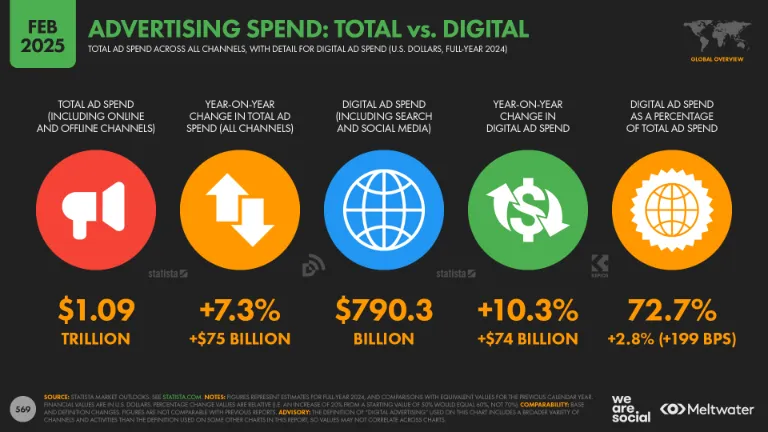
But all that money has to account for something–real results that come in the form of revenue, growth, and impact.
For marketing leaders, the most pressing challenge is to move from “spray and pray” advertising to strategies that drive conversions and improve the customer experience.
So, let’s take a step back and look at what the future holds and, more importantly, what brands and agencies can do to do well in that future.
P.S. Struggling to turn ad spend into real revenue? Or tired of campaigns that get clicks but no conversions? 9AM helps you scale with a performance-first approach that turns attention into action. Book your strategy call and see what profitable growth actually looks like.
TL;DR
- Advertising is shifting from attention to action. Traditional awareness-focused campaigns are declining in performance due to oversaturation, ad fatigue, and banner blindness.
- AI is reshaping every aspect of digital advertising. From predictive analytics and real-time optimization to generative AI for creative production, AI is central to improving campaign outcomes.
- The death of third-party cookies is accelerating the adoption of first-party data strategies. With privacy regulations tightening, marketers will need consented data from owned channels for targeting and measurement.
- Intent-based targeting outperforms interest-based models. Focused on high-conversion segments, outcome-driven campaigns now prioritize actions over reach.
- Each ad medium is evolving. Programmatic, social media, video, and connected TV are becoming more data-driven, integrated, and optimized for business results.
- Ethical and sustainable advertising is gaining momentum. Transparency, consent, and environmental responsibility are now part of what defines effective brand marketing.
The Shift from Attention
Many advertisers assumed that capturing eyeballs, visibility, reach, and sheer exposure was enough. That approach is increasingly ineffective or will be in the near future.
Why, you ask? Let’s look at the most obvious reasons.
Oversaturation of Platforms and Ads
Nearly all digital platforms, but particularly social media ones, make money through ads. What that means is that, regardless of the platform the users are on, they’re seeing ads (unless they pay for an ad-free version, like the one offered by YouTube).
People are seeing over 5,000 ads every day. So, they’re constantly exposed to ads from all sorts of brands, including your competitors.
Needless to say, there’s a lot of noise. And cutting through that noise requires strategic content and precise targeting (which will become even more challenging in the future, as we’ll discuss shortly).
As more brands double down, the competition for audience attention intensifies. And consumers, bombarded across devices and channels, have grown fatigued. Multiple ad units, banners, pop-ups, video ads, and social media posts, all vying for the same attention, result in signal overload for potential customers.
This brings us to the second reason.
Declining Attention Spans and Banner Blindness
Audiences are becoming increasingly indifferent to ads. They understand it as the necessary evil of the ‘online experience.’ And that has birthed what’s called banner blindness.
Research shows that as many as 86% of internet users now suffer from banner blindness. That study was from 2013. Imagine what it’s like now.
Even among ads that are technically “viewed,” many don’t register meaningfully. Viewers scroll past before an ad loads or dismiss anything that looks like a typical ad block. Studies confirm this as a persistent behavioral pattern.
For instance, in the following image, a heat map shows where the user pays attention, and as you can clearly see, it’s not where the display ads are.

Campaigns must move beyond mere visibility toward meaningful customer interactions and measurable business outcomes. Attention-only campaigns like banner ads, display ads, and generic impressions are becoming far less effective at influencing customer behavior or driving conversions.
What Will Be the Role of AI in Advertising in the Future?
Of course, the future of anything at this point is somehow linked with AI, and advertising is no exception. AI is rapidly becoming the engine driving smarter, faster, and more outcome‑oriented campaigns.
For marketing leaders in established enterprises, this shift promises to turn vast amounts of raw data and fragmented audience insights into actionable, measurable results. But it will also seep into areas like production, testing, and optimization.
AI to Make Sense of Raw, Unstructured Data (Predictive Models)
This is the most consequential advantage of AI for advertisers. AI’s ability to analyze massive and complex datasets, including images/videos, historical transactional data, website interactions, and even social media posts, can be indispensable for understanding and forecasting consumer behavior.
For example, predictive analytics helps brands anticipate:
- Which segments of their audience are most likely to convert?
- When are they likely to act?
- Which combinations of ad format, timing, and targeting yield the highest ROI?
This ability to forecast customer behavior and optimize targeting in real time transforms how enterprises approach campaign planning. It can enable smarter budget allocation, cross-channel marketing decisions, and outcome-driven strategies.
We’ll see a lot of AI in ad analytics with more diverse data inputs than we’ve seen before.
Gen AI for Faster Production and Creative Testing
Beyond data and targeting, AI is also shaking up the creative side of advertising. Generative‑AI tools, such as large‑language models (LLMs) and image/video generators, allow marketing teams to produce ad copy, visuals, and even video content at scale. They can quickly iterate creative variations to see what resonates best.
Christina Inge, author and Harvard educator, explains how AI is powering marketers:
“It really makes your work easier to be able to sketch something out through AI, show it to your client or boss, and then have them give feedback on that, versus creating multiple iterations of the same product. It’s a real efficiency driver.”
But this acceleration also unlocks creative testing frameworks previously impractical at scale. You can automatically produce dozens or hundreds of ad variants, then test which creative + message + audience combination drives the strongest performance.
For a large enterprise, that means you can adapt marketing content dynamically without overburdening creative teams or blowing budgets on trial‑and‑error.
85% of marketing teams were already deploying GenAI, and 83% report measurable ROI. These numbers are only going to get higher.
AI in Ad Platforms: Real-Time Automation and Optimizations
AI isn’t only helping behind the scenes. It’s increasingly embedded directly into advertising platforms. AI algorithms, for targeting, bidding, and even creative generation, learn from performance data and user signals to automate ad bidding and optimize placements or budgets in real time to maximize conversions.
A prime example of that is Google’s Performance Max Ads that essentially use AI for everything. Here’s how it works:
- Advertisers add campaign assets (images, videos, headlines, CTAs, etc.) and set the target (CPA or ROAS).
- The algorithm whips up an ad, bids, and optimizes it to make it more relevant for the audience.
- This happens across the different Google channels, like display, search, YouTube, and Gmail.
Other platforms have also introduced such AI capabilities within their Ad products, for example, Meta Advantage+ or TikTok Smart+ Ads.
According to Single Grain, integrating AI-driven predictive bidding and automation into paid media campaigns can increase ROI by up to 30% and lower manual overhead.
The Death of Third-Party Cookies and Increasing Privacy Regulations
The way audiences are tracked, targeted, and analyzed is undergoing a fundamental transformation. And that’s reshaping the very foundation of digital advertising, aka third-party cookies. This is the most popular projection for the future of advertising that cookie-based tracking will, in fact, be phased out.
Third‑party cookies, which advertisers use to track users across websites and build profiles for targeting, are losing support. Many major browsers have already blocked or restricted them by default (Firefox and Safari in particular).
Moreover, mounting public concern around privacy and increasing regulatory pressure have accelerated the shift. In 2025, 69% of advertisers reported that the deprecation of third‑party cookies will have a greater impact on their operations than even landmark laws such as the General Data Protection Regulation (GDPR) or the California Consumer Privacy Act (CCPA).
That’s a clear sign these advertisers need to be better prepared for a cookieless advertising.
The Shift Toward First‑Party Data and Privacy‑First Approaches
In the post-cookie environment, first-party data (information collected directly from users via your own websites, apps, or other owned channels) will be the winning formula. After all, first‑party data is more accurate, privacy-compliant, and under your control.
Brands that invest in first‑party data collection, paired with transparent consent practices, stand to gain customer trust, better audience insights, and a sustainable advertising foundation.
Many feel like the end of third‑party cookies is not a loss per se, but a reset. It’s a chance to rebuild customer relationships around transparency, permission, and genuine value rather than surveillance.
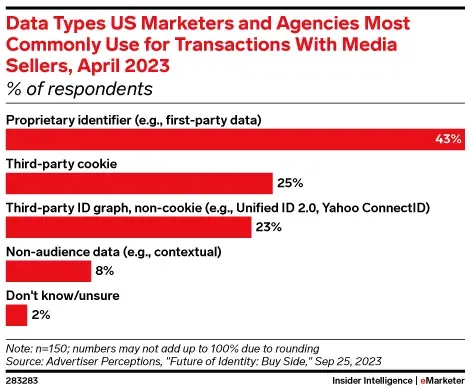
43% of marketers are already using first-party data for transactions with media sellers, more than third-party cookies (25%), as per Emarketer.
The Rise of Action-Focused Advertising
As we identified at the beginning of this guide, the future of advertising is looking a lot more action-focused. Gartner says CEOs and CFOs have greater expectations from CMOs and marketing divisions. In fact, it plainly says that a CMO’s job success hinges on marketing performance.
Clearly, the writing is on the wall. Companies don’t want to spend huge amounts of cash on marketing and ads that do little for actual brand growth. And that’s what’s ushering in the era of performance marketing.
Optimization and Targeting for Outcomes
Optimization for outcomes matters more than sheer impressions. Instead of just buying broad reach and hoping for engagement, marketers will need to embrace performance‑based models. That means they would need to pay only when a specific action occurs, like a sale, lead, or conversion.
Awareness-only campaigns may not die entirely, but they certainly won’t command an important enough budget.
Data, specifically revenue-focused metrics, will become the most important distinguishing factors between what works and what doesn’t. Depending on campaigns and underlying goals, the key metrics could include:
- Conversion rates
- Cost per action
- Cost per acquisition
- Customer lifetime value
Other metrics, like CPC or CPM, will be necessary for fine-tuning campaigns, but they might not be enough on their own to satisfy leadership.
Why Intent > Interest
So, how will advertisers prioritize actions based on audience data? The answer is intent.
A key driver of action‑focused advertising is the shift from “interest‑based” to “intent‑based” targeting.
Interest-based advertising targets broad audiences with general interests (such as browsing behavior or demographic signals), which is useful for awareness and top-of-funnel branding.
Intent-based advertising, in contrast, homes in on potential customers who show more ready signs of purchase intent. For example, that could be someone already searching for the product you’re selling, visiting product pages, or comparing features.
Intent-based campaigns have a 220% higher CTR. And 82% of B2B marketers say intent-based leads convert quickly.
The Future of Advertising By Medium
Now, let’s look at the trends and projections for different types of ads. Spoiler alert: video will continue to dominate.
Programmatic Advertising
Programmatic advertising, the automated, data‑driven buying and placement of ads across digital channels, will be important for many marketers. Rather than manually negotiating placements, programmatic uses real‑time bidding (RTB), machine learning, and algorithms to target audiences with precision.
Here’s what’s going to happen moving forward:
- Programmatic advertising space will continue to grow: The programmatic ads market is projected to exceed $235 billion by 2033, growing at nearly 30% from 2025.
- AI will take the reins: Demand side platforms (DSPs) will heavily incorporate AI to accelerate and optimize the ad buying process.
- Increased use of out-of-home (OOH) and connected TV ads: Programmatic advertising will also penetrate into digital OOH and CTV ads.
Social Media Advertising
With no surprises, social media advertising will remain one of the most influential and cost-effective ways to reach and engage audiences.
According to recent data, social media ads account for around 40% of all digital ad spending, which reflects how central social platforms are to modern marketing strategies.
So what does the future hold?
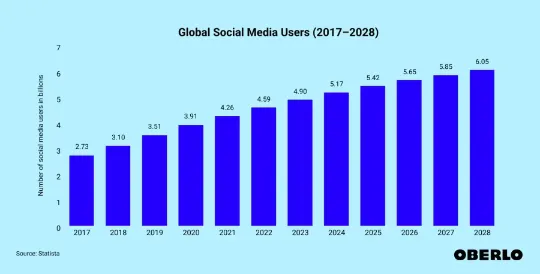
- More people join the platforms: As the world population grows and internet penetration increases, even more folks will join social media platforms (an even bigger audience for marketers).
- Ad spend to skyrocket: The global social media ad spending is expected to reach $433 billion, which is a clear indication that marketers are doubling down on these platforms.
- Brands will waver towards smaller digital spaces: According to Sprout Social, users want brands to prioritize smaller social spaces for user interactions like Discord, Reddit, Facebook Groups, and Instagram Broadcast Channels.
- User-generated content (UGC) will be more impactful than simple branded ads: UGC as ad creative can deliver a stronger punch as it’s more relevant. 75% of marketers find this type of content more authentic.
- Age limits on social media: Regulations will also crack down on age limits of social media use, as projected by Sprout Social. Australia just announced a new regulation for social media platforms to prevent use by under-16s (or face hefty fines).
See how 9AM helped Booksy grow business registration by 1,700% with authentic creator partnerships.
Video Advertising
Video in advertising is a whole category in its own right. Video-based advertisements have historically done very well, and there’s little to suggest that would change anytime soon.
It’s fair to say that video will remain a core part of paid media strategy as far as creative type goes.
- Global video ad market to reach $163 billion: The global digital video ad spending is projected to increase and take the market from $82 billion in 2025 to $163 billion in the next five years.
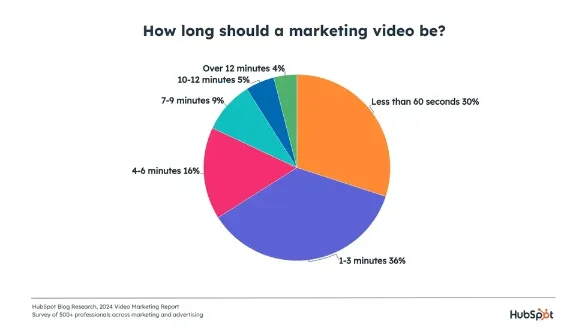
- The rise of short-form video as a primary growth driver: Short-form video (60 seconds or less) will remain relevant, primarily driven by platforms like TikTok, YouTube Shorts, and Instagram Reels. And most marketers agree, as shown in a HubSpot survey.
- AI for quick video generations: Nearly half the marketers use gen AI for videos. However, brands have been somewhat hesitant to use AI-generated videos as ad assets. But that could change with the ultra-realistic results from Sora and, particularly, Google’s Nano Banana Pro. It would, at the very least, accelerate idea and prototype testing.
- People want to see more videos: 91% of consumers want more videos from brands. That means image-only ads and content may not do as well as video.
Connected TV Ads
Connected TV (CTV) advertising, which includes ads on streaming services like Hulu, Disney+, and YouTube TV, is one of the fastest-growing channels.
Here’s why it’s going to matter in the future of ads:
- Global CTV ad spend is expected to increase dramatically: Global spending on Connected TV advertising is forecasted to reach up to $46.9 billion in 2028.
- CTV ad spend may even exceed online video spending. In 2025, U.S. CTV ad spending is projected to be approximately 43% larger than ad spending on standard online video formats. That goes to show it’s the fastest-growing digital ad channel.
- Completion rates for CTV ads remain exceptionally high: Connected TV ads average 90%-98%, far surpassing completion rates for standard mobile or desktop video ads, due to the non-skippable, lean-back viewing environment.
- A majority of CTV ad transactions will be programmatic: In 2025, around 70% of Connected TV ad transactions were expected to be conducted programmatically with real-time optimizations.
Sustainability and Ethical Advertising
Sustainability and ethical advertising are intrinsically linked, requiring brands to communicate their commitment to the Triple Bottom Line (people, planet, and profit) with complete transparency and integrity.
Ethical advertising requires truthfulness, respect for consumers, and avoidance of manipulative practices. For instance, breaching privacy and collecting data for targeting without consent is a big no-go (from both an ethical and compliance perspective).
This is critically important for sustainability to prevent greenwashing, the act of making false or misleading claims about a product's environmental or social benefits.
That said, advertising a brand’s sustainability efforts that are genuine and backed by data can actually be quite rewarding. That’s because sustainability has been and will be on the agenda of consumers, especially in mature markets.
Consider this: 80% of consumers said in a survey that they prioritize eco-friendly products.
Sustainability and ethics will impact all aspects of ads, including data collection, targeting, use of AI, and the products or services being promoted.
Interactive and Immersive Experience (AR and Ads)
Another technology that may pave new avenues for ads is augmented reality (AR). Interactive and immersive experiences have long been favored by users, but their adoption overall has been low.
That could change with products like Meta AI glasses, which seamlessly integrate immersive AR into real-life experiences and how users navigate the online world.
Unlike passive consumption, these experiences enable a two-way dialogue, which allows consumers to "try before they buy" with virtual fitting rooms, place furniture in their homes using AR (like IKEA), or take a virtual test drive in a VR showroom.
So, these experiences could complement digital ads. And as more people start using AI glasses, we can see ads incorporated into the visual apps people see (just as they see ads on mobile apps on their phones).
How Brands Can Prepare Today
As the advertising space inches toward privacy‑first, data‑driven, AI‑powered strategies, enterprises should not wait. Now is the time to proactively rebuild infrastructure, reorient teams, and realign budgets so you’re ready for the future of advertising.
Here’s the blueprint:
- Rebuild your data infrastructure: Successful future advertising rests on owning and unifying your customer data. Investing in reliable first‑party data strategies by aggregating data from your website, app, CRM, email, loyalty programs, and other touchpoints into a unified customer profile.
- Train creative teams for performance storytelling: Your teams should adapt and produce creatives designed not for eyeballs or impressions, but for conversion, engagement, and customer experience. Combined with AI‑powered tools and data‑driven insights, creative content should be oriented toward motivating specific customer interactions, such as signups, purchases, form‑fills, or other business outcomes.
- Shift budgets from impressions to incremental actions: Traditional budget allocation was, in part, heavily weighted toward reach, impressions, and awareness. But going forward, brands should reallocate toward performance‑oriented models, such as conversion‑focused campaigns, CPA, and/or ROAS, tightly tied to measurable outcomes.
- Run perpetual testing frameworks using AI and first-party data: The future is iterative. Rather than launching one-off campaigns, brands should set up continuous testing frameworks that use AI‑powered analytics and performance data to experiment with audience targeting, creative variants, timing, and channel mix. Then deploy the winners at scale.
Elevate your Performance Marketing with 9AM
Building this future advertising stack requires external expertise: technology vendors, AI‑based platforms, data‑oriented agencies, and analytics partners. What if you could get that with a singular partner?
9AM is a performance-driven agency that prioritizes profitability, and that’s the future of advertising and marketing.
Our approach is ROI-driven with real metrics to show exactly how campaigns contribute to customer acquisition, sales, or overall growth, whatever your goal may be.
With real-time reporting and direct access to project managers and strategists, everything is transparent, and you’re always in the loop.
Ready to talk strategy, media buying, or influencer acquisition? Book a call.
FAQs
How will advertising change in the future?
Advertising is shifting from broad, attention‑based campaigns to performance‑driven strategies rooted in outcome metrics, first‑party data, and AI-powered insights. The rise of AI and predictive analytics means ads will increasingly focus on real customer interactions and conversions rather than just impressions or visibility.
Will third‑party cookies end after 2025?
That’s no longer certain. While many in the industry expected third‑party cookies to be phased out, major players have delayed or revised those plans. For example, Google has delayed the end of cookies and instead given users more control.
How will AI impact advertising?
AI is already transforming how ads are planned, created, and optimized. AI‑powered platforms can analyze first‑party and behavioral data to produce audience insights, enable real-time bidding and placement optimizations, and even generate creative content.
How will regulations affect ad targeting?
Increasing privacy regulations and changing browser policies are pushing the industry toward more privacy-respectful practices. As third‑party cookies become less reliable or are widely blocked, marketers are turning to first‑party data, consented-user information, contextual advertising, and privacy‑preserving technologies.
Will it be more expensive to advertise in the future?
Not necessarily. However, the mechanics of cost and value may shift. While some legacy targeting tools may become less effective (which could make certain ad buys less efficient), AI‑powered advertising and data-driven strategies may deliver better ROI by focusing spend on audiences most likely to convert.
How does 9AM help brands adapt to the future of advertising?
9AM builds performance systems rooted in first-party data, AI-powered optimization, and outcome-driven strategy. The focus is on profitable growth, instead of vanity metrics.
What makes 9AM different from traditional media agencies?
Traditional agencies optimize for impressions. 9AM optimizes for revenue. Every campaign is built with clear attribution, rapid experimentation, and transparent reporting that ties spend directly to business outcomes.
Does 9AM support full-funnel strategy or just media buying?
Yes, 9AM covers the full performance stack: media buying, creative strategy, influencer acquisition, funnel design, analytics, and measurement. The goal is to improve conversion and scaling opportunities across the entire customer journey.