

Anyone can approve a budget. The real challenge is ending the month on target without waste, panic, or surprises.
Up to 26% of marketing budgets are wasted due to poor planning, misallocation, and last-minute spending decisions. If that number makes you uncomfortable, it should.
The final week of the month is where good performance goes to die. Budgets are either underspent (leading to missed revenue and lost opportunities) or forced into campaigns that can’t make use of these additional resources efficiently, which drives spikes in customer acquisition cost (CAC).
The pressure to “use it or lose it” turns smart marketers into reactive ones.
But month-end chaos is not inevitable. With the right budget pacing strategy, the final days of the month can become one of many success stories for your brand.
Let’s break down how to turn reactive spending into a controlled, calculated efficiency win.
In this blog, we’ll cover:
- What budget pacing means and how to calculate it correctly
- Why budget pacing is critical for protecting ROAS, CPA, and spend efficiency
- The core budget pacing principles marketers should follow
- Strategic month-end pacing tactics that prevent last-minute spend spikes
- The role of automation vs human oversight in managing budget pacing
- How to use data and predictive insights to guide smarter pacing decisions
- A practical month-end pacing checklist to keep campaigns efficient
P.S. When month-end still feels like a scramble, 9AM can help you build structured budget pacing systems that eliminate surprises. We design executive dashboards, forecasting models, and weekly operating cadences that directly link spend to performance. If you’re ready to turn budget pacing into a competitive advantage, book a strategy call with us today!
TL;DR
- “Spend it or lose it” thinking destroys ROAS and drives inefficient month-end decisions.
- Smooth, demand-aligned daily pacing consistently outperforms erratic budget dumping in the final week.
- Automation, including Smart Bidding, scripts, and rules, improves responsiveness, but only when paired with disciplined human oversight.
- Real-time, cross-channel data visibility is the only reliable way to prevent overspend, underspend, and budget leakage.
What does Budget Pacing Mean?
Budget pacing is the rate at which your marketing budget is spent over a defined period. This could be daily, weekly, or monthly.
You can consider it as a control valve that helps you balance volume and efficiency.
Spend too fast, and you inflate customer acquisition costs (CACs) and disrupt learning. Spend too slowly, and you leave money on the table.
Your objective is not simply to spend the full budget. The goal is to control spending so it aligns with performance targets and broader marketing objectives.
And budget pacing also doesn’t mean you have to spend the exact same amount every single day, either.
In fact, most major ad platforms are designed to do the exact opposite.
Google Ads treats your daily budget as an average. This allows campaigns to spend more on high-opportunity days and less on quieter ones, so your total spend still stays within the monthly cap.
This fluctuation is driven by real market forces like search demand spikes, auction competition, conversion likelihood, seasonality, and even day-of-week behavior.
Budget pacing usually receives the most attention towards the end of the month-end. This is when daily variances finally reconcile against a fixed monthly budget.
With the average marketing budget representing about 7.7% of overall company revenue, small pacing errors can compound quickly.
And without active oversight, those deviations can leave you either scrambling to cut spending at the last minute or realizing too late that you missed out on valuable demand that you had sufficient resources to attract.
How to calculate budget pacing?
To calculate budget pacing, start simple: divide your total monthly budget by the number of days in the period to get your target daily spend.
Monthly Budget ÷ Days in Period = Target Daily Spend
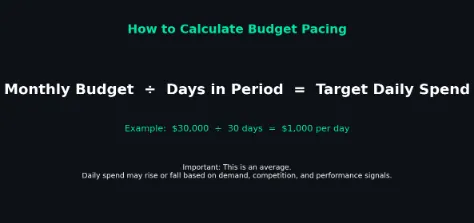
This number is an average, not a fixed daily requirement. So, it’s normal for some days to run higher and others lower depending on demand, auction pressure, and conversion likelihood.
From there, refine your target using your historical conversion rates, day-of-week performance patterns, and known demand swings.
Expert tip: We recommend a weekly pacing review. A quick check helps confirm that spend remains close to plan while the month still allows time for adjustments. This way, there’s still enough time to correct without hurting efficiency.
Why Is Budget Pacing Important?
Let’s suppose it’s the 27th of the month, and you’re still 18% under budget.
But you haven’t yet hit your revenue targets.
Suddenly, the conference room conversation shifts from “Where can we generate the highest return this month?” to “Where can we offload our remaining budget so it doesn’t go unused?”
This shift is subtle but dangerous. And avoiding this month-end dilemma is exactly why budget pacing is so important.
Let’s take a closer look.
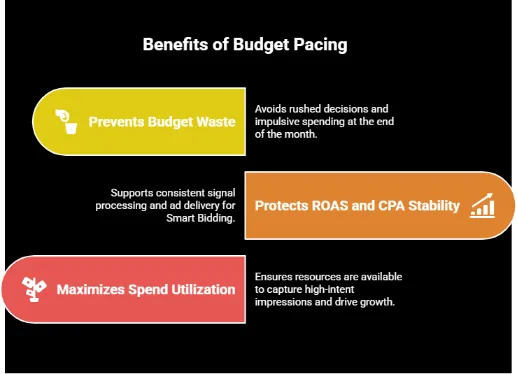
1. Prevents Last-Minute Budget Waste
When there’s leftover budget in the final stretch of the month, teams mostly feel the pressure to “just do something.” This usually means entering more auctions, raising bids, or broadening targeting just to get spend out the door.
However, these rushed decisions usually ignore the original campaign strategy. Your team likely built campaigns around a defined audience, a clear efficiency target, and a specific return expectation.
This is where many teams run into trouble.
A marketing budget exists to be invested carefully. Without discipline and direction, spending quickly turns into waste.
That impulsive spending also has other hidden risks.
When many brands rush to push out unused budget at the same time, competitive pressure increases, and CPM (the cost to reach 1,000 people) also rises. This reduces overall efficiency as more bidders push up auction prices.
In other words, you’ll pay more to reach the same audience while efficiency declines.
Sudden budget changes can also disrupt machine learning. Altering the budget by more than 20% may reset or destabilize the learning phase for Smart Bidding strategies. And when learning gets disrupted, cost per acquisition (CPA) can swing unpredictably.
So, without pacing discipline, “maximizing budget usage” usually becomes the reason performance deteriorates in the final week of the month.
2. Protects ROAS and CPA Stability
Smart Bidding systems like Target CPA and Target ROAS rely on consistent inputs to optimize effectively. Stable budget pacing supports stable signal processing and ad delivery.
This doesn’t mean your budget must remain the same throughout the entire month.
What creates problems is large spending swings in either direction. When budgets rise or fall too quickly, delivery patterns shift and audience exposure changes.
Once this happens, conversion modeling begins to recalibrate. And unexplained CPA spikes become more noticeable.
We have observed that many teams assume bidding strategies will absorb sudden budget changes without impact. In reality, algorithmic systems still rely on stable inputs to maintain efficiency.
Consistent pacing keeps budgets aligned with actual demand patterns and preserves algorithmic momentum instead of interrupting it.
3. Maximizes Spend Utilization and Market Share
Here’s the part many teams miss: underspending is not always conservative. In many cases, it quietly limits growth.
Lost Impression Share (Budget) measures how often your ads were eligible but didn’t show due to budget constraints. Every percentage point lost represents demand you could have (and should have) benefited from.
Disciplined pacing ensures you have the resources to capture available high-intent impressions early and consistently. Done correctly, pacing turns budget control into revenue growth.
It protects the margin while defending the market share, balancing both growth and profitability.
Budget Pacing Principles to Follow for Consistent Performance
Up to this point, we’ve talked about why budget pacing matters. Now let’s talk about how to actually do it well.
These are the three principles that separate the reactive spenders from the effective.
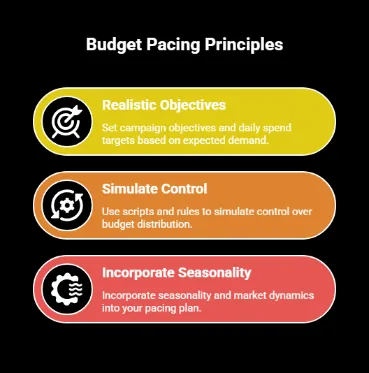
1. Set Realistic Campaign Objectives and Daily Spend Targets
We’ve seen too many leadership teams approve a clean monthly number and assume the work is done. It isn’t.
A monthly budget without a daily structure is just a vehicle with no steering wheel.
High-performing teams break that number into daily and weekly pacing targets tied to expected demand. This means calculating your average daily spend, then adjusting based on historical performance patterns.
If weekends convert higher than weekdays, your budget shouldn’t pretend that Monday and Saturday are identical.
Meta recommends aligning budgets with expected performance windows and demand shifts rather than distributing evenly across time. This is where pacing multipliers come in.
Increase allocation for paydays, promotional periods, or historically strong conversion days. Ease back during low-intent windows.
2. Overcome "Standard" Limitations: Simulate Control with Scripts & Rules
There was a time when Google Ads offered “Accelerated Delivery” for Search and Shopping campaigns. This option was deprecated, leaving “Standard” delivery as the default.
Standard prioritizes an even budget distribution. This approach provides stability, but it can also limit responsiveness during high-demand moments.
For example, purchase intent may increase during product launches, promotions, or short demand spikes. Standard delivery may still distribute spend cautiously in order to preserve the monthly cap. This behavior sometimes leaves the budget unused even when demand is strong.
Sophisticated teams don’t rely on default settings alone. They build their own throttle using Automated Rules or scripts. For example: increase bids or budgets by 15% during peak conversion hours, then automatically revert after the surge.
This mirrors the agility of Accelerated Delivery without losing control.
Google’s Automated Rules allow for scheduled bid and budget adjustments based on time and performance triggers. When you use it correctly, this technique improves your responsiveness to market changes and optimizes your budget pacing.
3. Incorporate Seasonality and Market Dynamics into Your Pacing Plan
Linear pacing assumes demand is evenly distributed. In practice, this rarely happens.
Search demand fluctuates based on consumer behavior, cultural events, and even weather. Demand spikes usually align with seasonal triggers and key buying moments, especially for eCommerce brands.
Smart pacing responds to those patterns instead of spreading spend evenly across the calendar.
In our experience, campaigns perform better when budgets reflect known demand patterns. This might mean front-loading the budget ahead of peak search periods or reserving allocation for historically strong final-week performance.
Remember that the best pacing plans adapt to the market, instead of following a rigid calendar structure.
Strategic Month-End Budget Pacing Tactics to Protect Efficiency
If the first three weeks are about steady pacing, week four is about protecting efficiency without losing momentum. Below, we have shared some tactics you can use to stay on top of budget pacing all month long:
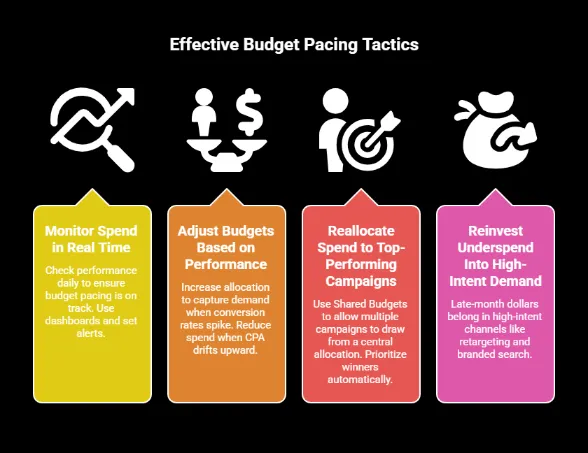
1. Monitor Spend in Real Time
It happens frequently: a brand checks pacing on Monday, assumes things are fine, and then discovers on Thursday that spend has surged past projections. At that point, options are limited.
During the final week of the month, intraday visibility is vital. We suggest checking your performance at least once a day to ensure your budget pacing is still on track.
Monitor performance by time and segment, so you can compare projected spend versus actual spend in near real time.
Use pacing dashboards that show:
- Month-to-date spend vs. planned spend
- Forecasted end-of-month projection
- CPA and ROAS (return on ad spend) trends alongside spend
And set alerts when pacing deviates by more than 10%. Waiting until tomorrow is how overruns happen.
2. Adjust Budgets Based on Performance
Strong pacing requires active adjustments. Budget decisions should always follow performance signals.
If the conversion rate spikes on a Wednesday due to demand, increase allocation to capture additional demand. If CPA drifts upward during low-intent windows, reduce spend to protect efficiency.
Google’s Smart Bidding strategies optimize bids in real time, but budget allocation across campaigns still requires executive judgment.
We have noticed that many teams focus too much on how much budget remains instead of evaluating performance quality.
Effective teams connect every adjustment directly to the Cost-Per-Acquisition (CPA) or Cost-Per-Lead (CPL) impact, rather than to how much budget is “left.”
3. Reallocate Spend to Top-Performing Campaigns
One of the most underused tools in Google Ads is Shared Budgets, which allow multiple campaigns to draw from a central allocation. When one campaign underperforms, and another outperforms, shared structures let the system prioritize winners automatically.
Without this flexibility, the budget gets trapped in low-volume campaigns while high-performing campaigns struggle to capture available demand.
Month-end efficiency improves dramatically when allocation stays responsive to results. As campaign performance changes, budget distribution should adjust as well.
4. Reinvest Underspend Into High-Intent Demand
If there’s budget remaining in the final days, resist the urge to spread it broadly.
Late-month dollars belong in high-intent channels, including retargeting, branded search, and bottom-of-funnel keywords.
Data shows that retargeted users are 70% more likely to convert compared to non-retargeted visitors.
These audiences already know you. That’s why they convert at materially higher rates than cold traffic.
Broad campaigns at month-end rarely mature fast enough to produce results. High-intent demand does.
Automation vs Human Oversight in Budget Pacing
If you’ve ever sat in a board meeting defending performance swings, you already know this tension.
“The algorithm will handle it” sounds reassuring, until it doesn’t.
Automation is powerful, but so is the human perspective. The best results come from both working together.
What Automation Handles Well in Budget Pacing
Let’s give credit where it’s due. Strategies like Target CPA and Target ROAS evaluate signals at the auction level in real time. Far faster than any human team could. Device, location, time of day, and intent signals: Google processes them all in milliseconds.
We have seen that under stable budget pacing conditions, automation thrives. When budgets are predictable and demand patterns are steady, algorithms optimize efficiently and protect return.
But remember that automation works best within guardrails. When you impose a hard month-end budget cap and only a few days remain, the system’s ability to self-correct narrows. It can optimize bids, but it cannot renegotiate your monthly ceiling.
Where Human Oversight Is Required in Budget Pacing
Google may spend up to 2X your daily budget on a given day to capture an opportunity, while still respecting your monthly cap. This flexibility is powerful, but if those higher-spend days cluster late in the month, you can quickly approach your cap.
Without safeguards, month-end overages are common.
It’s up to disciplined human teams to safeguard budget pacing by implementing:
- Monthly cap scripts that pause campaigns the moment targets are reached
- Circuit breaker rules that reduce spending if CPA spikes beyond tolerance
- Manual oversight in the final 48 hours
This doesn’t discount the advantages of automation. It’s necessary risk management.
| What automation handles well in budget pacing | Where human oversight is required in budget pacing |
|---|---|
| Auction-level bid adjustments based on device, location, time of day, and intent signals | Monitoring overall budget pacing against the monthly cap |
| Processing thousands of real-time signals that influence conversion probability | Deciding when to increase or reduce budget allocation across campaigns |
| Optimizing bids quickly during stable demand conditions | Preventing overspend when higher spend days cluster late in the month |
| Maintaining bid efficiency under consistent pacing conditions | Implementing safeguards such as monthly cap scripts and circuit breaker rules |
| Scaling performance within the limits of platform rules and budget settings | Reviewing performance closely during the final days of the month |
Enhance Control With Predictive AI Tools
Beyond native platform automation, predictive pacing tools add another layer of control. Platforms like Shape.io and Adpulse use forecasting models to smooth cross-channel spend and anticipate pacing risks before they materialize.
These tools help visualize where the month is likely to land. But even here, the pattern holds.
AI automates processes, and humans set priorities.
Automation can optimize bids at scale, but only leadership and expertise can decide whether growth, margin, or cash flow protection takes precedence in the final week of the month.
How to Fuel Budget Pacing With Data-Driven Decisions
Visibility creates control, and forecasting creates confidence. Together, they turn pacing into a leadership advantage.
Unify Cross-Channel Budget Visibility
Fixing one platform by breaking another is a classic misstep.
If Facebook overspends by 8%, that doesn’t automatically mean LinkedIn or Search should be cut. Especially if those channels are delivering strong ROAS.
Budget pacing must be evaluated across the total portfolio, rather than viewing channels in isolation.
We have noticed that teams focus on a single platform dashboard and assume that the channel alone explains the performance story. In reality, pacing decisions only make sense when the full account picture is visible.
Google Looker Studio allows you to consolidate spend, CPA, ROAS, and pacing projections into a unified dashboard.
When you can see total account pacing versus total account efficiency in one view, decisions become strategic rather than reactive.
You stop asking, “Which platform is over budget?”
And you start asking, “Are we investing more in what’s driving results and less in what isn’t?”
That’s a much better question.
Use Predictive Data to Anticipate Month-End Risk
Historical spend velocity is one of the most underused forecasting signals in marketing. If your account accelerates in the final 10 days, this pattern will likely repeat unless controlled.
Google’s Performance Planner is designed specifically to forecast spend and performance scenarios based on historical data. It allows teams to simulate budget increases or decreases and model projected outcomes before making changes.
Don’t wait for CPM spikes or demand shifts to hit when you can run scenario planning in advance.
Forecasting allows you to prepare earlier. For example, scenario planning can help answer questions such as:
- What happens if demand surges 15% next week?
- What happens if the conversion rate declines?
- How will this upcoming holiday affect end-of-month pacing?
Data shows that teams that rely on data-driven scenario planning can generate between 25% and 70% more return from the same level of investment.
Your Month-End Budget Pacing Checklist: Downloadable
Successful month-ends are built early. This checklist helps keep your spending controlled, efficient, and drama-free.
Weeks 1–3: Establish Pacing Control
The first three weeks determine whether Week 4 feels strategic or stressful.
Your objective: enter Week 4 with less than 10% variance from plan. Here’s what you should prioritize:
- Compare daily spend vs. target pacing
- Monitor projected end-of-month spend
- Track Lost Impression Share (Budget) to identify missed demand
- Add negative keywords to eliminate waste
- Adjust bids based on performance trends, not instinct
Remember: Small gaps are manageable. Large ones leave room for bad decisions.
Final Week: Protect Efficiency and Control Risk
This is where your discipline will really pay off.
The goal: finish exactly on budget. No overspend, no stranded dollars. Here’s the path to a strong finish:
- Increase pacing checks (these should be daily at minimum, but check multiple times a day if there is high variance)
- Tighten CPA or ROAS targets if costs drift
- Pause keywords, audiences, or placements that are bleeding budget
- Monitor daily budget behavior
- Validate projected end-of-month totals before scaling spend
Post-Month Review: Optimize the Next Pacing Cycle
High-performing teams treat post-month reviews as intelligence-gathering sessions. Here are the insights that will guide future campaigns:
- Review Lost Impression Share (Budget) for missed growth
- Compare the final CPA to the monthly average
- Identify demand patterns (mid-month spikes, final-week compression)
The goal is to learn enough from the prior month's performance to adjust next month’s daily pacing targets based on observed trends. Every month should feel smoother than the last.
P.S. Want to keep this process consistent each month? Download this “Month-End Budget Pacing Checklist,” so your team can use it during pacing reviews and campaign planning.
Master Budget Pacing and Protect Efficiency With 9AM
Anyone can grow spend. The real discipline is scaling performance without letting efficiency slip in the final stretch of the month.
The real win is finishing the month on budget, on target, and without last-minute chaos. That requires more than automation alone. The future of efficiency belongs to teams that combine disciplined human oversight with intelligent systems that respond in real time.
9AM helps you master the math behind multi-channel pacing, so you can focus on strategy instead of scrambling over spreadsheets.
If your team wants to eliminate the month-end scramble and maintain consistent performance, book a strategy session with us.
Frequently Asked Questions
How can I monitor budgets to ensure efficiencies?
You can monitor budgets efficiently by using a centralized dashboard that shows projected spend versus actual spend, CPA or ROAS trends, and Lost Impression Share. Set automated alerts for pacing deviations above 10% and review data weekly early in the month, then daily in the final week.
What is the 70/20/10 rule for marketing budgets?
The 70/20/10 rule allocates 70% of marketing budget to proven, revenue-driving channels, 20% to growth initiatives, and 10% to experimental or innovative campaigns. This framework balances performance stability with controlled experimentation. To maximize results, each allocation tier should be paced and measured against defined efficiency metrics such as CPA or ROAS.
What is the 50/30/20 rule budget?
The 50/30/20 budget rule typically assigns 50% of your resources to core acquisition, 30% to optimization and scaling efforts, and 20% to testing and innovation. It supports steady growth while preserving flexibility. Effective pacing within each category ensures budgets are fully capitalized on without compromising efficiency or exceeding monthly caps.
Can 9AM help in developing budget pacing strategies?
Yes! We develop structured budget pacing frameworks, executive dashboards, and decision-making cadences that align spend with performance goals. By combining automation, predictive forecasting, and human oversight, we help you finish each month on budget while protecting ROAS and growth targets.
Which methods are most effective for budget pacing to ensure efficient spending as the month closes?
The most effective budget pacing methods include setting daily spend targets, monitoring real-time variance, tracking Lost Impression Share, using automated rules with manual safeguards, and reallocating budget toward high-intent campaigns. Combining structured oversight with automation ensures month-end efficiency without overspending.