
Social media ads may seem easy to pull off, but you need a solid ad brief that takes into account platform behavior.
This applies to Meta and TikTok ads even more (if that’s possible!).
The problem is that teams see the similarities between Reels and TikToks and think they can reuse the same structure across the entirety of both platforms. And end up wondering why performance drops.
This guide breaks down the true differences between TikTok and Meta ad briefing, with examples that show how you can start briefing differently today.

TL;DR
- TikTok = native, creator-led, fast iteration
- Meta = structured, conversion-optimized, controlled messaging
- TikTok briefs prioritize angles and hooks
- Meta briefs prioritize offers and clarity
- Creative strategy must move beyond targeting the same profile on different platforms and match the platform behavior instead.
- A combined Meta and TikTok strategy is best for full-funnel activation.
Why Most Ad Briefs Fail Across TikTok and Meta
Most ad briefs fail across TikTok and Meta because brands make two major mistakes. These are:
Reusing the same structure
Copy-and-paste briefing does nothing but lower your engagement rates while costing you more money.
What’s worse is that it can put you behind your competitors who are making platform-native ads. In fact, ads made specifically for TikTok have a 27% higher completion rate compared to generic repurposed ad structures.
You can also fail to hook watchers in the 1-3 second mark (which is a huge deal on TikTok).
And the reverse of the medal is also true: your TikTok brief wouldn’t lead to the type of conversions you can get with a Meta-first ad format.
Misaligned inputs
Wrong information and incomplete research are the enemy when briefing for any type of ad, but for Meta and TikTok, it’s the kill-switch.
We’ve found that when teams don’t ensure their audience targeting, creative strategy, and messaging are all correct, their performance suffers.
As a tip: Always remember that Meta thrives on granular targeting while TikTok is trends and rapid awareness.
In other words, Meta and TikTok don’t interpret inputs the same way.
- On Meta, targeting and intent signals drive delivery, so your brief needs to be precise about audience segments, pain points, and conversion goals.
- On TikTok, distribution is driven by content signals, so your brief needs to focus on hooks, formats, and cultural relevance.
If you feed both platforms the same inputs, you lose efficiency because you simply end up building ads that neither system knows how to optimize.
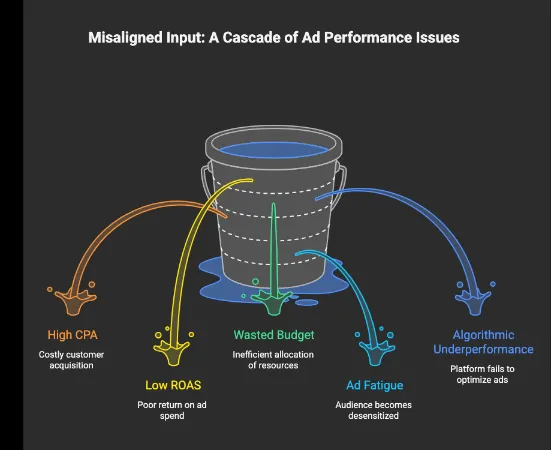
These errors jumble up platform priorities. In the end, this leads to creative fatigue that reduces how effective your campaigns are because the target audience has seen your ad too many times. This makes your cost-per-click way higher than it should be, thereby sinking ad spend.
What Makes TikTok and Meta Ads So Different
To understand what separates TikTok and Meta briefs, we need to start by looking at the general nature of each advertising platform and what that means for the ads you post there.
Even though Instagram Reels is more or less a like-for-like rival to TikTok, there are still audience differences between the two.
Meta offers a wider range of formats. You can run:
- Static posts/ads
- Carousel ads,
- Story posts
- Dynamic product ads and
- Instant experience ads
Each format gives you a different way to present the same message, depending on your goal.
These capabilities span across its social media sites, including Facebook, Instagram, Threads, and, to a lesser extent, WhatsApp.
TikTok is more standardized on paper, but not limited. Most ads are video-first, yet the variety comes from execution.
- Spark Ads
- Creator-led content
- Trend participation
- Native storytelling formats
… create very different outcomes, even if the format looks similar.
So while Meta gives you more format flexibility, TikTok demands more creative adaptability within a narrower structure.
We’ll break down how to brief for each in the sections below. For now, let’s explore more platform differences between Meta and TikTok:
Platform Intent
The platform intent is determined by your audience needs. What the audience expects from a TikTok video and a Meta ad is usually worlds apart, so the messaging can’t be the same across both.
What this means is your TikTok briefs have to address relatable pain points with humor and maybe join a trend or two. And your Meta briefs should have a clear value proposition, while leaving room for trust-building with social proof of what your solutions do for customers.
User Behavior
This is where the gap between what works on Meta and TikTok is the most visible.
“TikTok currently rules trends, feelings, and culture for Gen Zers, who make up 60 percent of the app’s one billion-plus users. Gen Zers flock to corners of the internet where they can discuss their passions and interests with those who share them.” - McKinsey & Company
Data from Neil Patel shows that TikTok is, indeed, Gen Z’s favorite channel. They scroll TikToks for 92 minutes per day, whereas the combined time spent on Facebook and Instagram is 58 minutes/ day for this generation:
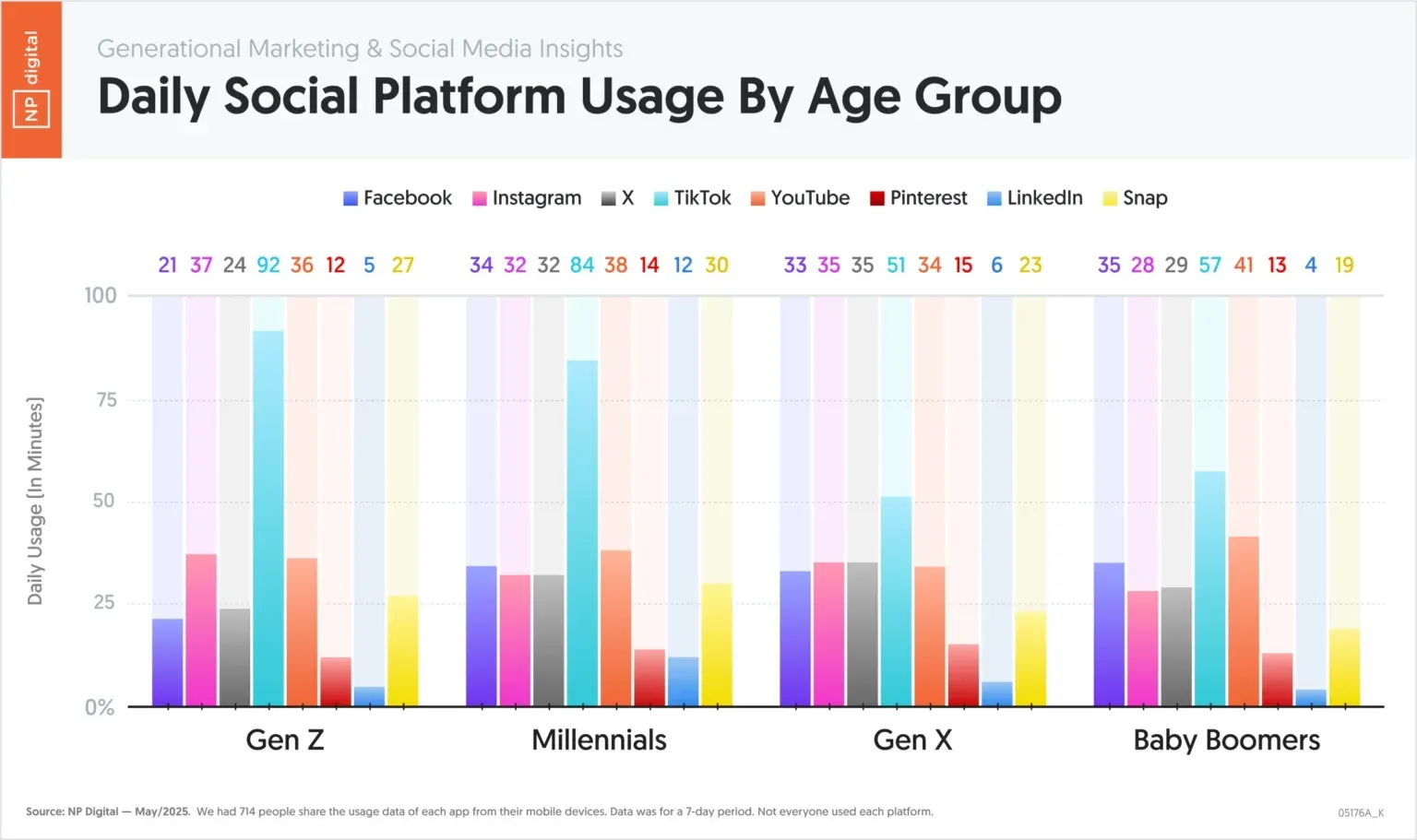
This makes your hooks vital.
For Meta ads, your briefs should have hook ideas to spark curiosity, while almost immediately closing that loop by giving the audience the solution.
On TikTok, users care more about sharing their passions and interests. So you can be a lot more creative and don’t exactly have to follow the problem/solution briefing style of Meta.
Algorithm Differences
TikTok’s algorithm rewards attention and engagement (which appear to be declining because of several factors we discuss here), and Meta’s algorithm shows relevant posts based on historical user data.
Ad structures on both are vastly different because of this.
What this would mean for your briefs is:
- For Meta, a focus on traditional copy formatting in briefs. In our experience, that means ads flow from problem to solution and end with a CTA.
- For TikTok, you should focus on authentic content. This will usually mean partnering with UGC creators or using that casual style in your ads.
Pro Tip: Facebook ads can stay 30-60 days within targeting and retargeting cycles, so think sustainability when briefing. TikTok ads have a way shorter shelf-life, so brief weekly or bi-weekly for your creators to fight ad fatigue.
How to Brief for TikTok Ads: What to Include for Native, Scroll-Stopping Creative
Winning briefs on TikTok make your ads feel like organic posts that add to the user's scroll experience so they don’t break their ‘flow’. Understandably, nobody likes being interrupted when trying to unwind, so your brief must take that into account and make the ad feel like part of the scroll.
What a TikTok Ad Brief Needs to Include
A TikTok brief should turn your campaign goal into a creative direction that fits the platform. Whether you want to build awareness, increase engagement, or drive conversions, the brief needs to define how the content should capture attention and feel native to the feed. As such, your brief for any post must include:
- A strong hook + retention structure: Open with a scroll-stopping hook, then maintain attention with pattern breaks, curiosity gaps, or mini-hooks throughout the video.
- Clear content angles: Define the approach. This could be a pain point, a trend, a POV, a transformation, or a storytelling format. Don’t leave the creative direction open-ended.
- Creator direction: Specify tone, delivery, and level of polish. Should it feel raw, scripted, ironic, or educational? If you're using UGC or creators, guide without over-controlling.
- Loose scripting, not rigid scripts: Provide structure and key beats, but leave room for natural delivery. Over-scripted TikToks tend to underperform.
- Platform context and references: Include examples of trends, sounds, or formats you want to tap into.
- Clear outcome or CTA: Even for awareness-style content, define what action you want. Follow, click, search, or buy. If it’s not specified, creators will default to nothing.
Example TikTok brief
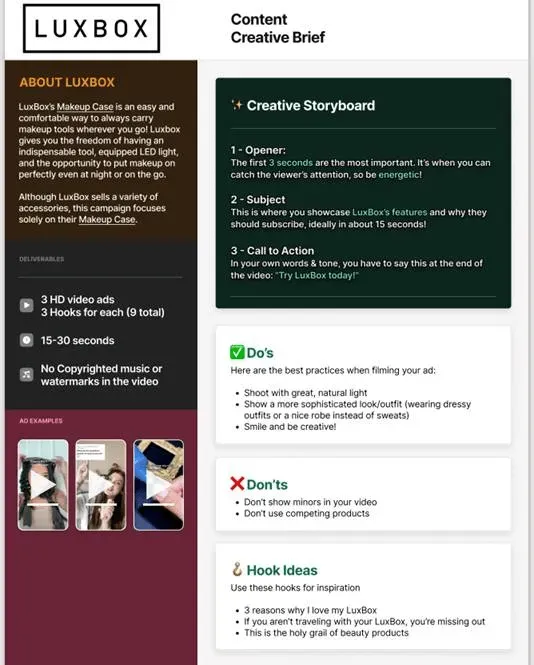
Common mistakes
TikTok briefing mistakes usually stem from how marketers see the platform. We’ve found that marketers try to fit TikTok into the mold of traditional ads or even Instagram. This mindset causes mistakes like:
- Producing rigid briefs that lead to overpolished ads:
TikTok users don’t like to feel like they’re being propositioned. Plus, 90% of users say authenticity matters when they support brands. That’s arguably more important for Gen Z.
To fix this mistake, simply cut down on over-scripting your briefs and even lean more on UGC-style videos. Also, encourage your creator-partners to use their own voices where appropriate.
- Weak or missing hooks:
Some briefs don’t account for just how crucial the first 3 seconds of a TikTok are. If the hook isn’t strong enough or is missing key elements, the ads will get swiped over and eventually shown less on FYP’s.
You can start fixing this by having strong hook variations like relatable pain points or bold questions in your briefs.
- Vague CTAs:
Giving creators some artistic freedom over what they say in videos sometimes means you may forget to tell them where to direct traffic and the views they get.
When partnering with creators like micro-influencers, brands should clearly spell out the actions they want the audience to take in their briefs.
- Failing to brief for subcultures:
TikTok works just like an ant farm because there are so many distinct niches and communities. Sometimes a brief can target a segment that isn’t really differentiated by the essence of what the site considers a niche.
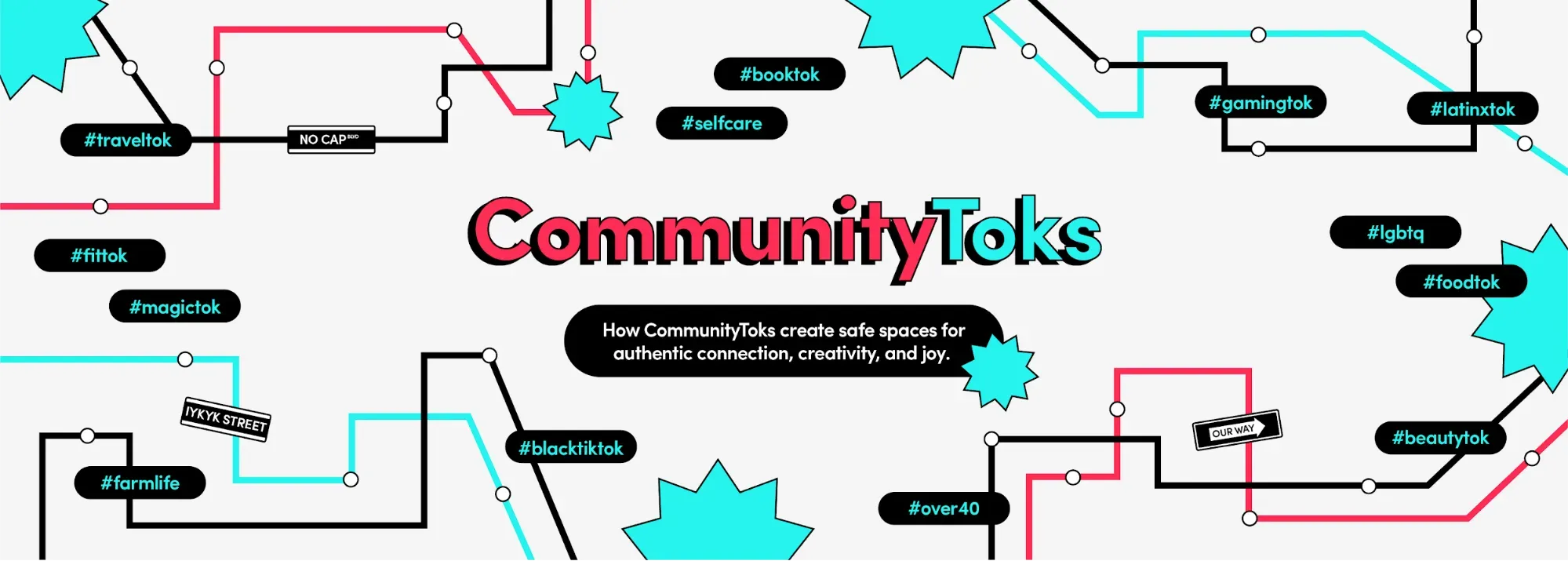
For example, targeting Gen-Z instead of briefing for defined subcultures like BookTok, BikerTok, UpholsteryTok, etc.
How to Brief Meta Ads: Structure, Targeting, and Conversion Focus
Meta ads let you target users based on online behavior, location, and profile history across Instagram and Facebook. There are even options to retarget lookalike audiences. Creative still matters, of course, so don’t completely cut off the excitement part of your briefing just yet.
What a Meta Ad Brief Needs to Include
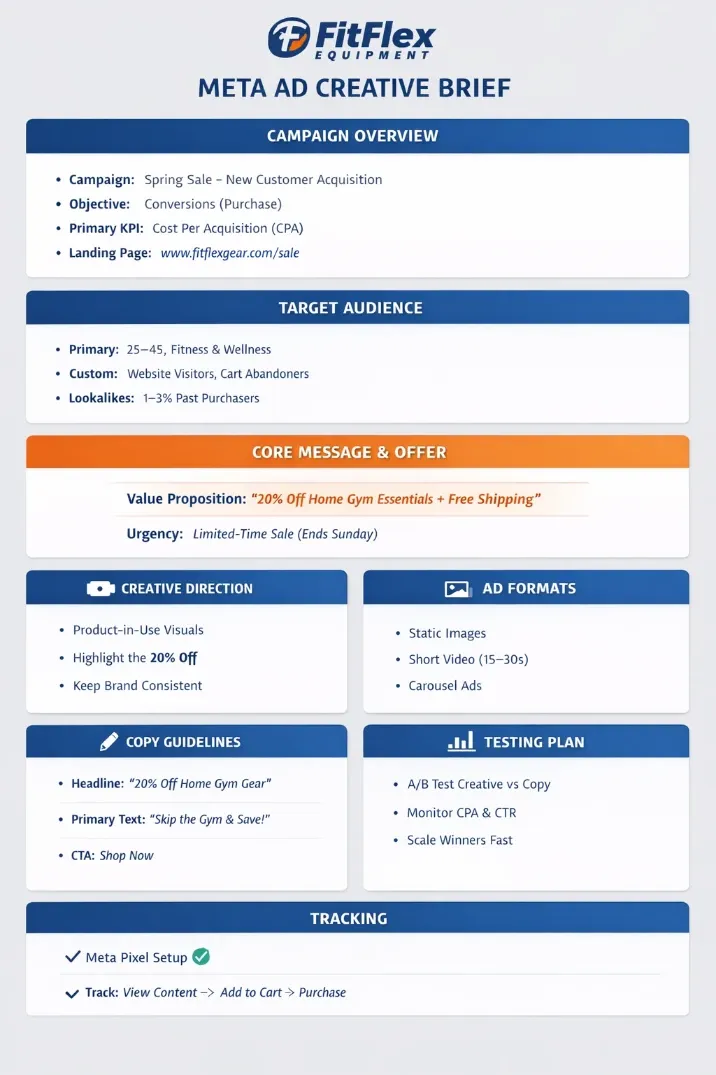
A Meta brief centers on structure, audience profiling, and constant tracking and testing. The goal behind the briefing here is to convert. That means your briefs must include:
- A clear offer and your value proposition must be front and center
- Defined audience segments and the different messaging variants you have for each section
- Fully structured copy that flows naturally from a headline, lead, body copy, to CTA.
- Variants for creative. Since Meta gives a bunch of different ad formats, you should add the options available to your briefs. Also, add the lengths and placements you’re considering to your briefs.
- Specify what you’re testing and how. Define the variables (creative, copy, audience, offer), what changes between variants, and what success looks like. Without this, you’re not learning properly from your ads.
Example Meta brief
Common mistakes
Meta relies heavily on data, so your ability to plan is everything. That said, many an ad spend has been lost because of poor planning. Mistakes that spring up include:
- Unclear objective definition:
Some Meta ad briefs state everything except the end goal of an ad campaign. As a result, brands will end up falling back on their general business goal as a north star.
So now they have switched priorities; like chasing traffic metrics when what they really want is conversions (and Meta is better for sales than viral moments anyway).
- Targeting too broad or narrow an audience while completely ignoring retargeting:
Just like with TikTok, marketers may target too wide an audience and end up appealing to nobody.
But where it gets tricky with Meta ads is that if you get too specific with the audience, you also cut off potential customers and don’t have enough data for Meta’s analytics to help you in future campaigns.
This’ll lead to running multiple campaigns when you could just use retargeting to scoop up users who showed interest but didn’t make it all the way (such as abandoned cart data and website visitors).
- Weak creative with zero variants:
Meta may be the more polished cousin of TikTok, but it doesn’t mean creatives shouldn’t be imaginative.
Briefs can sometimes be over-templatized, and even for audiences willing to hear what you have to say, the Meta crowd won’t stop their scroll if an ad doesn’t feel relevant enough.
Tip: Creative that’s ‘mobile-friendly’ (optimized for vertical video), reduces costs significantly in our experience. Meta lets you test multiple creative variations, so brief for that too!
- Neglecting tracking capabilities like Meta Pixel:
With GDPR and 3rd party tracking restrictions tightening every year, some brands still forget they need to take signal attribution into their own hands.
But some teams still launch campaigns without properly tracking user actions on their site. That means they don’t know who clicked, who added to cart, or who converted.
Without that data, you can’t define accurate audiences, build retargeting segments, or refine your messaging. As a result, your briefs rely on assumptions instead of real user behavior.
Key Differences in TikTok vs Meta Ad Briefs
The differences in how briefs will look for each platform can be summarized in a table:
| Key Point | TikTok | Meta |
|---|---|---|
| Creative Direction | Loose, experimental, and led by creators (if you’re using them) | Controlled, brand-safe, and structured |
| Messaging Strategy | Story and entertainment come first | Value proposition and clarity come first |
| Production Approach | Fast and high volume due to the low cost of production | Polished ads that scale well because assets can be used over and over for retargeting |
| Testing & Iteration | Rapid iteration based on creative performance | Structured A/B testing across ad variants and other variables |
TikTok Ads vs Meta Ads: Brief Examples for Each Ad Format
We’ve talked a lot about how TikTok and Meta ads are different. While some of those differences are limited to the audience data you get, what you do with that data, and ultimately how your briefs will look, is decided by the ad formats you follow for each platform.
TikTok Ad Formats and How to Brief Them
Spark Ads (UGC)
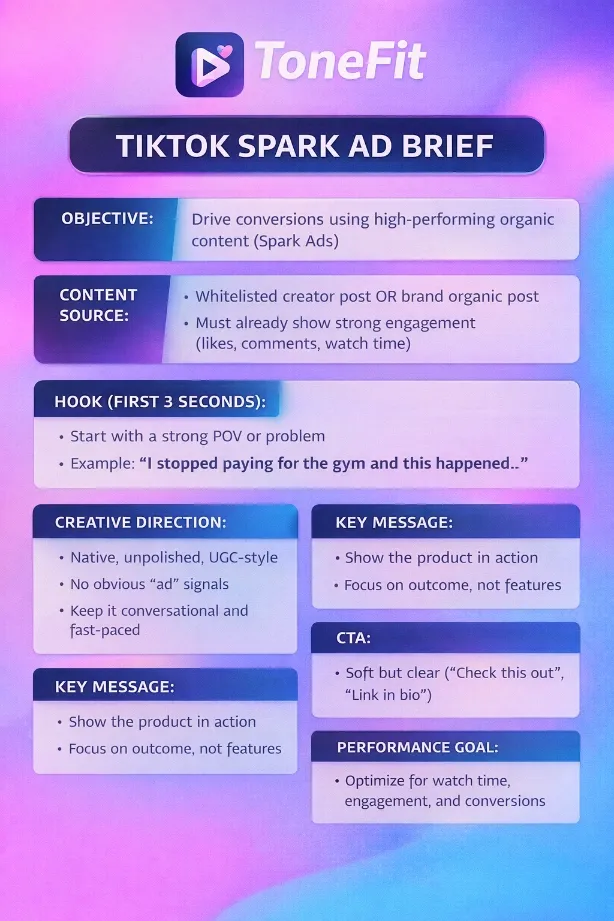
Spark ads are promotions of existing creator or brand videos, so any brief for them has to focus on being raw and real to come off as authentic. Briefing here is really laissez-faire, so your potential creators have the freedom to make videos that their audience will love without being too salesy.
Here, your brief structure will:
- State your goal, but not the specific actions
- Provide several hook options for creators
- Have a soft CTA that sounds super casual
- Encourage organic style camera angles, voiceovers, or trending sounds
In-Feed Ads
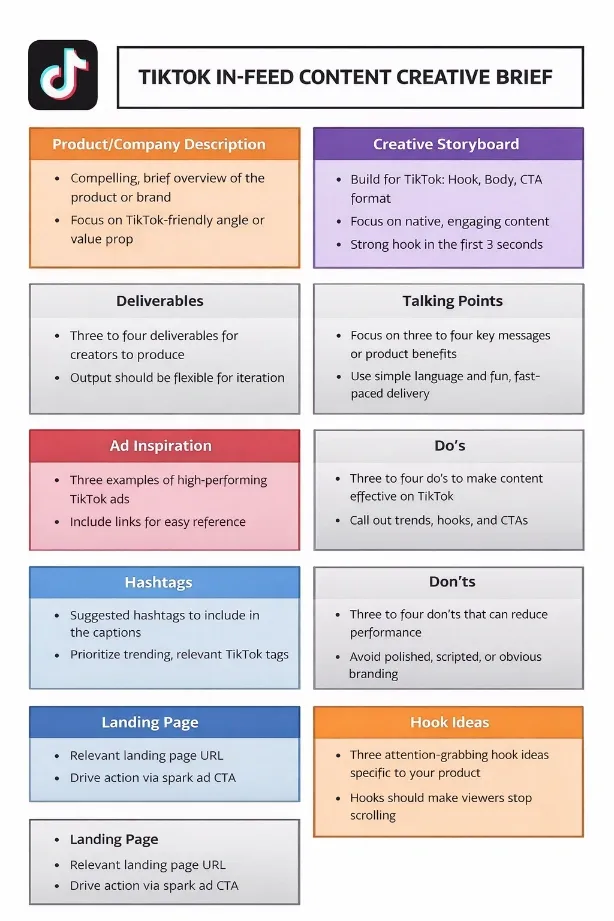
Just like spark ads, in-feed ads are designed to blend right into users’ feeds. But unlike spark ads, they can clearly be told apart as clear marketing material, with options for buttons, links, and captions. Because of this, the briefing for this format has to be semi-structured with a clear pathway of:
- How to hook new users in the first 3 seconds
- The concept of the campaign’s videos
- The ‘body’ of your video (words and even the energy levels required for creators)
- A clear call-to-action
Hashtag / Trend-based
Sometimes you need a hashtag strategy, too, because TikTok hashtag challenges can get cutthroat. And just adding “#fyppppppp” or “#viral” won’t cut it. In the same way, spamming 15 tags is a no-no.
This means that, along with 1-2 general tags, you need 2 - 3 additional hashtags relevant to niche-specific conversations happening around what your videos are about.
Briefing here is concept-based. So you have to get creative with making up trends and hashtags that users can participate in, or joining existing trends while they’re still hot.
High-Impact Formats (TopView, Brand Takeover)
These formats dominate the screen and don’t rely on native behavior. Your goal is to capture attention immediately.
Your brief should:
- Define a single message and outcome (no multiple angles)
- Establish brand presence within the first second
- Use bold, simple visuals that are instantly readable
- Avoid overcomplication. These formats don’t reward nuance
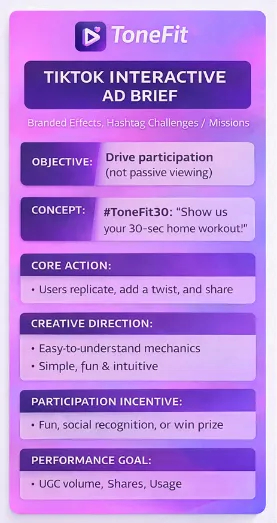
Interactive Formats (Branded Effects, Hashtag Challenges / Missions)
These formats depend on user participation. Remember: you’re briefing a behavior.
Your brief should include:
- The core action users should replicate
- A simple, clear concept that’s easy to participate in
- A reason to engage (fun, social proof, reward, trend)
- Examples or references to guide execution
- Guardrails; don’t include word-for-word scripts
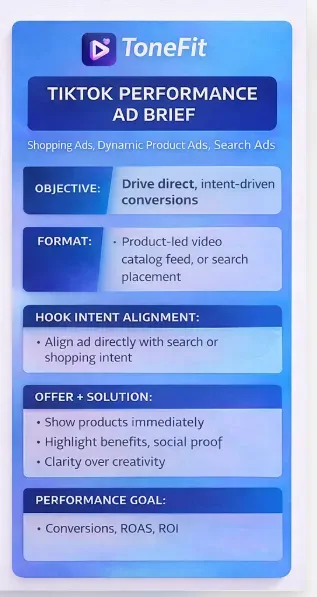
Performance Formats (Shopping Ads, Dynamic Product Ads, Search Ads)
These formats are closer to Meta in logic. They rely on product clarity and intent, not just discovery.
Your brief should define:
- The product or offer clearly and early
- The audience intent (what problem they’re trying to solve)
- Messaging tied to outcomes or benefits
- A direct CTA and conversion path
- Variations for testing (offers, creatives, hooks)
Meta Ad Formats and How to Brief Them
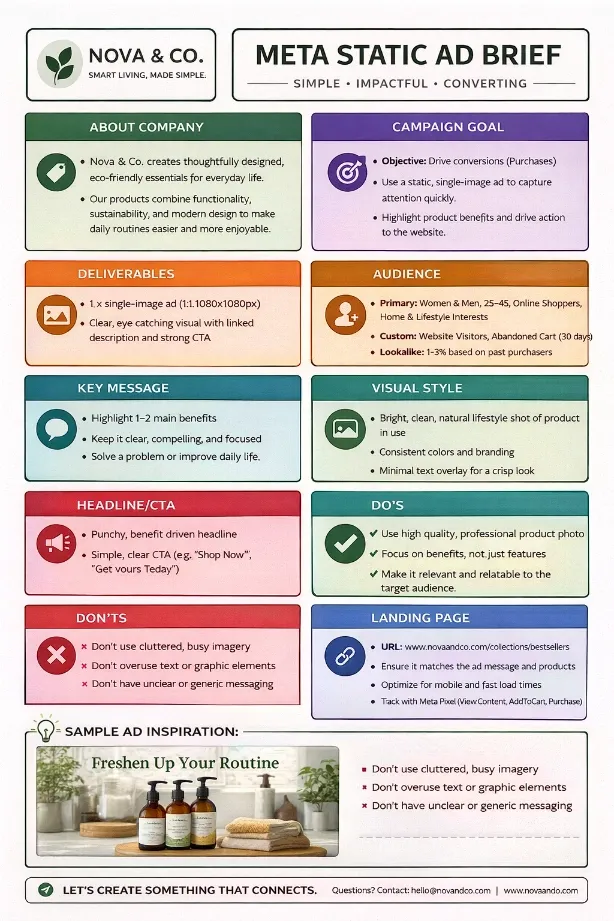
Static Ads
Static posts have been around on Facebook ads for a while and are similar to sales or landing pages in lots of ways. Just like with classic sales copy, you only have so much space to convey your offer clearly to the audience. Because of that, static ad briefs are highly structured with defined frameworks like P-A-S, limited-time offer, or social-proof copy.
Carousel Ads
With carousel ads, each card is a part of a larger story but can stand alone without losing meaning. This means the briefing style centers on modular messaging, with clear descriptions of what the entire gallery should conceptualize (e.g., a how-to guide), while still packed with relevant information on every slide.
Briefs are still extensively structured. Here’s an example:
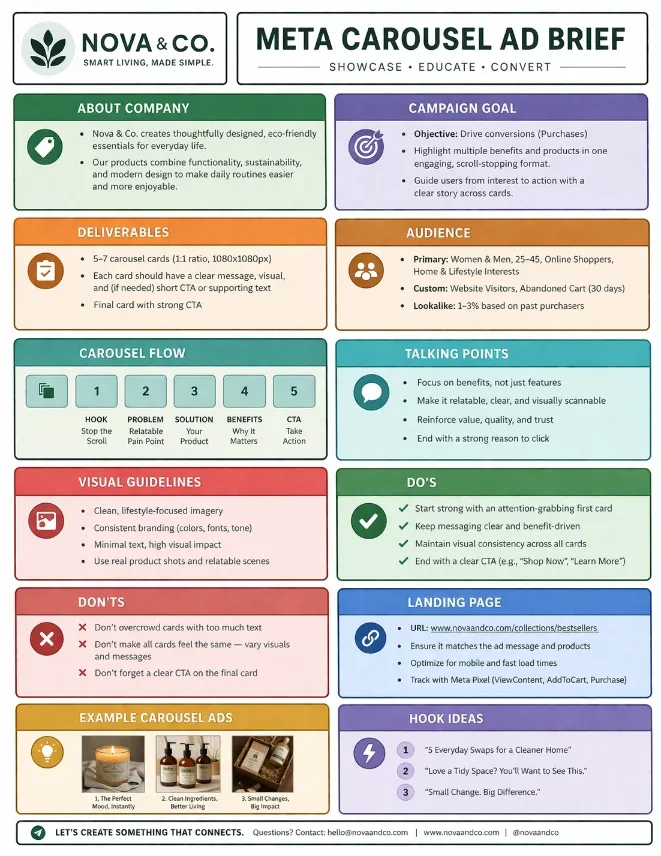
Tip: Remember to turn off ‘Best Card Fit,’ or it rearranges your carousel slides and breaks the logical flow.
Video Ads
Unlike TikToks, Meta video ads rely heavily on scripting to create controlled emotional narratives that guide the user base from being unaware of your offer to making a purchasing decision.
Think of briefing here like creating a video sales letter, but with much more emotion and creativity on display. You’re also keeping sentences short and to the point, as your videos won’t be more than a minute on average.
The Real Cost of a Bad Brief
To calculate the real cost of a bad brief, let’s see how much Meta ads and TikTok ads cost (Source: Metricool 2025).
| Cost metric | Meta Ads | TikTok Ads |
|---|---|---|
| CTR | 2.5% | 4.9% |
| CPM | $0.33 | $0.32 |
| CPC | $0.05 | $0.01 |
| CPA (leads) | $1.34 | $3.57 |
| CPA (App downloads) | $1.96 | $2.91 |
| CPA (sales/conversions) | $0.13 | $0.90 |
| Share of the total conversions | 61% | 20% |
Now, let’s say your brief isn’t clear on campaign goals. The client wants leads and conversions, but because the objective wasn't pinned down, your team splits a $500K budget evenly: $250K on Meta, $250K on TikTok.
The data tells a different story. Meta’s CPA for leads is $1.34 vs. TikTok's $3.57, and Meta drives 61% of total conversions compared to TikTok's 20%. For a conversion-focused campaign, Meta should be doing the heavy lifting.
A strategically briefed allocation might look more like 80/20 in Meta's favor; that’s roughly $400K on Meta, $100K on TikTok.
Here's what that misallocation actually costs:
- With the wrong split: $250K on TikTok at $3.57 CPA = ~70,000 leads
- With the right split: $100K on TikTok at $3.57 CPA = ~28,000 leads, but the freed-up $150K moved to Meta at $1.34 CPA generates ~112,000 additional leads.
That's a swing of roughly 70,000 leads from the same $500K budget, just because the brief didn't clearly define the objective.
And that's before you factor in acquisition costs, creative production, and the compounding effect on revenue if even a fraction of those leads were to convert.
Briefing for Platform Behavior with 9AM
Social ads perform best when you respect the formats that work for each channel, and align your creative to the corresponding platform behavior.
Briefing may seem like another admin task you do “just because”, but that’s where many social media marketing managers get it wrong. Its main purpose is to be a strategic lever that propels your performance marketing success while keeping your ad spend at acceptable levels for your budget.
We advise you to rethink the structure of your briefs along these lines and see how those metrics suddenly start to look a lot better.
Need extra help?
9AM helps brands and companies that want to speak in the language of their customers. You get to reach the right audience on the platforms that align best with your brand position.
So whether your goal is creating some buzz around your product/service or getting to the heart of making a sale, you can speak to audiences that are ready to listen.
Book a strategy call with us now, and we can audit your current briefs or draw up roadmaps for new ones. That’s how we’ll trace the customer journey religiously through your marketing funnel.
FAQs
Are TikTok Ads cheaper than Meta Ads?
Yes. Typically, your average CPC and CPM will be lower on TikTok, making it vital for brand awareness.
But once you get past that initial click, conversions happen indirectly more often than not. This makes the cost-per-action (CPA) of TikTok ads higher than Meta ads over the course of your ad campaigns.
Why do TikTok Ads need a different creative brief?
TikTok ads need to be briefed differently because the ad formats that perform are completely different from what you need on Meta. Campaign performance on the platform depends on native, engaging content rather than structured ad formats.
Can you use the same ad creative for TikTok and Meta?
The short answer is no, but honestly, it depends. You should always adapt your content to match platform behavior and user expectations.
That said, this doesn’t mean one creative strategy can’t complement the other. More often than not, TikTok and Meta ads work hand-in-hand to achieve your overall marketing and business goals.
Which platform is better for conversions: TikTok or Meta?
Instagram or Facebook ads simply close better thanks to Meta’s sophisticated marketing ecosystem and advanced targeting capabilities.
But don’t get it wrong, TikTok is coming up really quickly. It’s great at creating demand and curiosity, so you can say it “opens” better. But conversions still primarily happen outside the platform on places like Meta, and that’s why the best campaigns use both in sequence.
What type of content does well on TikTok?
Video content that feels authentic while being short and fast-paced does well on TikTok. So think UGC style content like storytimes, self-aware humor, and aesthetic product demos.
The trick to TikTok, in our experience, is meeting the natives of the platform where they’re at, and not trying to apply the rigid structures of traditional digital advertising.
How many creatives should you test on TikTok vs Meta?
On TikTok, volume wins. You’ll usually need at least 2x more creatives than on Meta because fatigue hits fast and performance drops quickly without constant iteration.
On Meta, testing is more controlled. Strong creatives last longer and can be reused, especially for retargeting, so you don’t need the same creative velocity.