Scaling ad spend doesn’t guarantee increased performance. In many cases, it does the opposite.
Nearly 75% of performance marketers report diminishing returns as they increase spend. This leaves a gap between investment and achievement that many refer to as the “Brand Tax.”
It’s easy to blame targeting, platforms, or rising competition. But the real cause is much simpler and well-documented: creative fatigue.
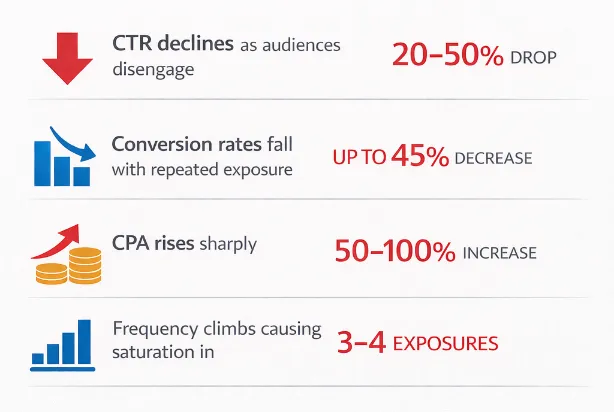
When the same ads target the same audiences repeatedly, performance declines fast.
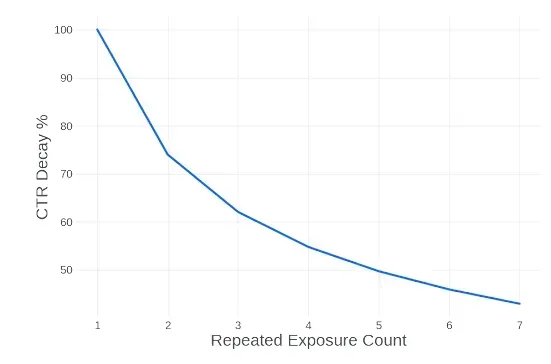
In fact, data shows that click-through rates (CTR) can drop by 45% after being exposed to the same creative four times, while cost-per-acquisition (CPA) increases by up to 50%.
So before you increase your budget again, it’s worth asking: is your creative built to scale?
In this article, we’ll cover:
- What the “Brand Tax” is and why scaling spend often leads to diminishing returns
- How creative fatigue impacts performance, ROI, and audience engagement
- Why creative throughput, not budget, becomes the real growth constraint
- How high-performing brands use testing systems, iteration, and creative velocity to scale
- What you can do to reduce fatigue and keep performance stable as you increase spend
P. S.: Are your campaigns driving impressions while CPA keeps rising? At 9AM, we turn creator content into structured performance assets built for testing, paid amplification, and measurable revenue impact. Book your strategy call and see how your current creative setup can work harder for growth.
TL;DR
- Scaling ad spend without scaling creative leads to diminishing returns, known as the “Brand Tax.”
- Performance doesn’t scale linearly. After initial gains, returns drop as audiences get saturated.
- Creative fatigue is the main reason performance declines, not targeting or platform issues.
- Repeated exposure to the same ads reduces engagement and increases CPA over time.
- Creative quality has a larger impact on performance than media placement or targeting.
- The real growth constraint is creative throughput, not budget. Brands need consistent output to sustain performance.
- Most in-house teams struggle because they lack the systems and capacity to produce and test creative at scale.
- High-performing brands rely on creative systems that prioritize testing hooks, formats, and angles continuously.
- Scaling performance requires volume, variation, and velocity in creative production and testing.
- Expert agencies like 9AM can help you solve this by providing structured systems, faster production, and scalable creative pipelines.
What is “Brand Tax?
The Brand Tax shows up when you increase paid media spend but see weaker returns on investment (ROI).
This happens because performance doesn’t scale in a straight line. It follows a curve. Results improve early on, then begin to slow as diminishing returns set in.
You can see this clearly in how spend translates to results. For example, the first $10K in ad spend might deliver a 150% ROI, the next $10K could then drop to 40%, and beyond that, returns may turn negative.
From what we’ve seen, this is where most teams get caught off guard. They expect performance to hold as budgets increase, but the dynamics change quickly.
This shift happens for two main reasons. First, campaigns reach your highest-intent audiences early. After that, you’re forced to spend more to reach colder, less responsive users.
Second, the same audience starts seeing the same creative too often. Engagement drops as familiarity turns into fatigue.
As responsiveness declines, your cost per result continues to rise.
That’s when the Brand Tax hits. You’re spending more, but getting less in return.
Creative Fatigue in Paid Ads: The Silent Growth Killer
Creative fatigue operates the same way on every paid channel. Performance starts off strong, then suddenly drops.
At first, fresh ads drive strong engagement. As exposure increases, that engagement drops. In many cases, this happens faster than expected.
In our experience, this becomes more visible when budgets scale against smaller, highly targeted audiences. The same creative gets served repeatedly within a short time frame.
Such campaigns can burn out in as little as 3 - 4 days.
This is where many teams run into trouble. The more precise your targeting is, the faster you saturate that audience.
As a result, your best-performing segments are mostly the first to fatigue.
This pattern is known as creative fatigue, and its impact is significant. Creative quality drives up to 56% of sales impact, compared to 44% from media placement and targeting.
As Stephan Vogel, chief creative officer at Ogilvy & Mather Germany, explains, creative has a greater impact on performance than most teams expect:
Nothing is more efficient than creative advertising. Creative advertising is
more memorable, longer lasting, works with less media spending, and builds a
fan community... faster.
So if the creative isn’t working, no amount of media spend can make up for it.
Creative Throughput in Paid Ads: The Real Llimit to Scaling Performance
Most brands think growth is limited by budget but the real limit is creative.
Creative throughput is your team’s ability to consistently produce fresh, diverse ad assets. Without that consistency, performance becomes difficult to sustain as spend increases.
Even if you increase your spend to infinity, platforms will always find impressions. But higher exposure won’t make weak or stale creative convert better.
This is where the problem starts. When throughput is low, creative fatigue sets in faster than you can replace your assets.
We believe creative should be refreshed every 1 to 2 weeks to maintain efficiency, particularly in high-spend campaigns.
Yet most brands still treat creative campaign assets as a one-off deliverable instead of an ongoing system.
So the real question is simple: can your current setup produce enough creative to keep performance stable as you scale?
Once you look at it this way, the constraint becomes obvious. It’s your ability to keep creative fresh at scale.
Why Most In-House Teams Struggle to Scale Creative Production
What we have noticed is that in-house teams are not broken. They’re just not built to produce the volume of creative needed to keep campaigns efficient at scale.
Most teams are small and specialized. Their structure doesn’t support high-output production, particylarly when platforms and algorithms are evolving daily.
At the same time, internal creative cycles can take weeks or even months. This gap creates friction.
Fewer assets and slower turnaround mean more missed opportunities to test, learn, and improve performance.
This becomes even more critical when you consider how much creative influences results. Data shows that creative ads perform 40% better than non-creative ones, and creative diversity can improve conversion rates by 13% compared to static campaigns.
Yet, many in-house teams lack structured testing frameworks, which makes it harder to identify and scale the most effective creative variants.
This is where dynamic creative optimization (DCO) changes the game. It uses automation to generate and test multiple ad variations in real time. This makes it easier to personalize at scale, reduces manual workload, and improves performance based on live data.
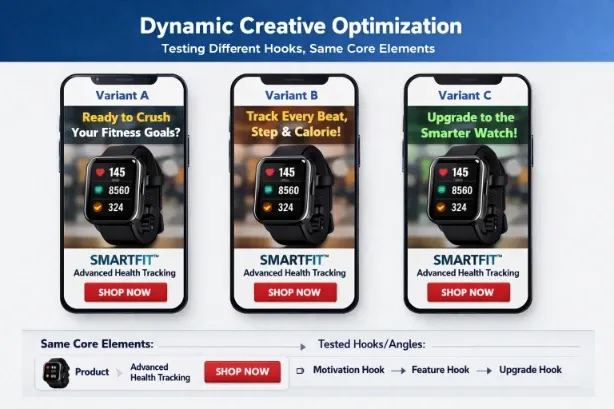
Instead of relying on slow, manual cycles, DCO streamlines production, removes bias from decision-making, and drives stronger engagement and conversion rates by serving more relevant creative to each user.
So, the issue with in-house teams isn’t talent, it’s infrastructure. Without the systems to produce, test, and iterate creative at scale, even strong in-house teams will struggle to keep up with platform speed and performance demands.
How Creative Systems Improve Paid Ad Performance
Once you recognize the problem as infrastructure, the solution becomes much clearer. You don’t need more campaigns. You need better creative systems.
From what we’ve seen, this is where most teams get it wrong. They focus on launching new campaigns instead of improving how creative is produced and tested.
Traditional marketing is built around perfectly polished, big ideas. Performance marketing works differently. It depends on speed, iteration, and continuous testing.
This means shifting focus from one-off campaigns to volume and variation. Instead of betting on a single concept, you test multiple hooks, formats, and messages at once.
This is where modular creative comes in. It breaks ads into components that can be mixed, matched, and scaled across different variations.
When you combine this with always-on testing, you create a continuous cycle of launching, learning, and improving.
Because at scale, the advantage becomes clear. Brands that grow consistently aren’t relying on single ideas. They rely on systems that produce and refine creative continuously.
How High-Performing Brands Fix Creative Fatigue at Scale
Once you understand where performance starts to break, it becomes easier to see what needs to change. High-performing brands take a different approach.
Below, we break down the systems and processes they use to keep creative fresh and performance stable as they scale.
1. Build a Creative Testing System
High-performing brands test creative continuously. In most cases, this means weekly or bi-weekly creative drops to keep performance stable.
This aggressive testing is necessary because attention spans are short and fatigue sets in quickly.
As per our experience working with various teama we have noticed that the most effective testing happens across three levels: hooks, formats, and angles
Hooks (first 3 seconds)
The goal here is to stop the scroll. People decide whether to keep watching a video ad within the first 3 seconds. This is a very short window to hook or lose your audience.
When you’re testing hooks, consider which opening grabs attention fast enough to earn the next second.
What to look for:
- Thumb-stop rate / hold rate (are people pausing or scrolling?)
- Early drop-off in video views
Best practices:
- Lead with motion, faces, or a bold claim
- Call out the audience or problem immediately
- Avoid slow intros or branding upfront
Formats (UGC, Static, Video)
Remember: formats don’t perform the same, and small differences here can change results more than expected.
In our daily practice, we have noticed that user-generated content (UGC) has become a clear frontrunner. In fact, 93% of marketers say UGC outperforms traditional branded content, and it delivers 28% higher engagement on social platforms because it feels native.
Video is another heavy hitter. Research shows that short-form videos generate 2.5X more engagement than long-form content, which makes them ideal for capturing attention quickly in fast-scrolling environments.
That said, static ads still have a role. They’re highly effective for brand recognition, product launches, and simple offers, where clarity and consistency matter most.
The key is not choosing one format and sticking to it. Performance usually comes from testing how each format behaves within your audience and platform.
What to look for:
- CTR and engagement differences across formats
- Cost efficiency (CPM, CPC) by format
Best practices:
- Use UGC when you want content to feel native and relatable
- Use video when you need to show or explain something
- Use static when clarity and speed matter
Angles (pain points, benefits, proof)
This is where performance usually shifts the most.
Data shows that angles alone account for roughly 70 to 80% of performance variation.
From what we’ve seen, changing the angle usually has a bigger impact than changing the format or visuals. It’s what gives people a reason to care in the first place.
As legendary advertising copywriter and direct response pioneer John Caples famously said:
I have seen one advertisement actually sell, not twice as much, not three times as much, but 19.5 times as much as another. The difference was the one used the right appeal and the other used the wrong appeal.
In other words, the way you frame the message can completely change the outcome.
The same product can be framed using multiple creative angles. For example:
- A problem → solution (“Struggling with acne scars?”)
- Social proof (“100,000+ 5-star reviews”)
- A transformation (“Before vs. after in 4 weeks”)
- A comparison (“$200 alternative vs. $39”)
Each angle taps into a different motivation. One will usually outperform the others, sometimes by a wide margin.
That’s why testing angles is critical if you want to scale performance.
2. Increase Creative Throughput
Increasing creative throughput sounds simple (just make more ads, right?). In reality, it’s where most brands hit roadblocks.
As a rule of thumb, high-growth brands aim for at least one new creative per week per $1K in monthly ad spend. At scale, this number should be closer to two.
Here’s how this translates in practice:
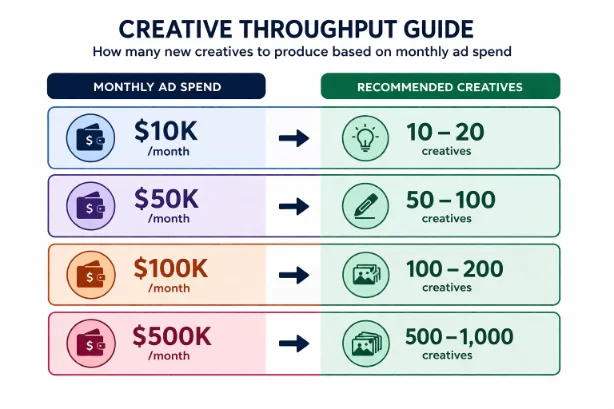
Production bottlenecks like limited internal bandwidth, extended approval cycles, increasing content costs, and the ongoing pressure to uphold brand consistency can hinder the ability to meet this demand.
What starts as a push for more creative quickly turns into missed deadlines and overworked teams.
Most in-house teams just aren’t built for that level of output and that’s okay.
This is where the right systems or external support start to matter. Agency partnerships can help bridge that gap by bringing the speed, structure, and scale needed to keep creative production consistent.
This kind of setup makes a measurable difference.
For example, when our team at 9AM worked with Prose, the goal was to build a system that could support consistent creative output. We developed a micro-influencer pipeline that continuously supplied new content for paid campaigns.
Each campaign included over 20 micro-influencers and generated more than 100 creative assets per month.
This level of output allowed for faster testing and iteration. Over time, it led to a 45% increase in ROAS year over year and a 20% reduction in customer acquisition cost.
Instead of scrambling to keep up, your campaigns stay fed with fresh creative without putting additional strain on your team.

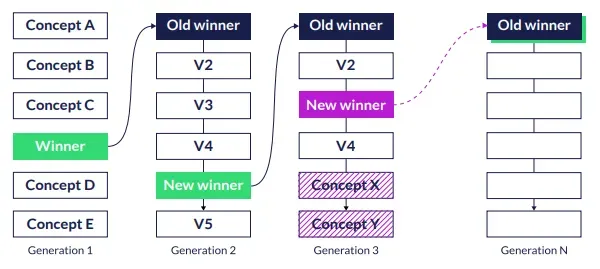
3. Iterate Winning Creatives Instead of Replacing Them
Most brands treat creatives like disposable assets. High-performing brands take a different approach. They build on what’s already working.
In our day-to-day work, we rarely replace a concept that’s already performing.
This is due to the fact that proven concepts already have strong signals, and resetting them means resetting performance. So rather than completely scrapping creative, we consider changing the finer details.
This is called iterative testing: keeping the core idea, structure, and message the same, while testing smaller elements within it.
Even subtle changes like swapping background imagery, adjusting CTA copy, or tweaking button design can drive meaningful lifts in engagement and conversions.
What to iterate:
- Hooks: new openings on the same concept
- Headlines: different phrasing of the same value prop
- CTAs: “Shop Now” vs. “Get Yours Today” (urgency matters)
- Visuals: new backgrounds, product shots, or colors
- Format tweaks: static → motion, or adding light animation
These aren’t major changes, but they’re enough to refresh attention and extend the lifespan of a strong creative.
Instead of throwing away what works, you keep your best ideas alive, while continuously improving their performance.
4. Match Creative to Funnel Stage
Creative fatigue doesn’t just come from showing the same ad too often. It also comes from showing the wrong message to the wrong audience.
This is one of the most common issues we see while working with various teams. The same creative gets pushed across the entire funnel, and performance starts to drop.
This doesn’t always mean the creative is weak. In many cases, it’s simply misaligned with where the audience is in their decision process.
When one message is stretched across every stage, fatigue sets in faster, and efficiency drops.
In fact, research shows that personalized messaging can drive 10 to 15% revenue growth by enhancing relevance. That’s because audiences have different needs at different stages:
- Awareness stage: At this stage, people are discovering the problem or brand. So, your goal is to grab attention immediately. For this, we suggest using bold visuals, unexpected messaging, or direct callouts that make people stop scrolling and pay attention.
- Consideration stage: Now, they’re evaluating options. Warm audiences need to build trust before moving forward. Here you can use testimonials, reviews, and social proof to drive consideration.
- Conversion stage: Here, they’re ready to act. Focus on removing friction. Use clear offers, urgency, and direct responses to common objections so nothing gets in the way of conversion.
This is where many teams run into trouble. They reuse the same “winning” ad across every stage, expecting it to carry performance on its own.
In practice, that approach leads to faster fatigue, wasted impressions, and rising CPA.
A better approach is to rotate creatives based on intent. This keeps messaging relevant, reduces overexposure, and helps maintain performance as you scale. Match the message to the moment.
How Expert Agencies Turn Creative into a Growth Engine
If your goal is growth, there may come a time when creative becomes an operational challenge. This is where agencies have the advantage.
Agencies bring scale, specialization, and systems that most in-house teams simply aren’t built to replicate.
Plus, they have access to a large creator network, high-volume production pipelines, and performance-tested frameworks refined across multiple accounts.
And when these capabilities are applied effectively, the impact becomes clear.
Take Hurom, for example. To scale a premium $699+ product in a crowded market, they partnered with our team at 9AM to build a full-funnel creative and media system.
And the result was quadrupled revenue growth, a 70% reduction in CPA, and 150M+ impressions across channels.

Speed is a major factor here. The faster you can produce and test new creative, the less time you spend relying on fatigued assets.
Another advantage is cross-client insight. What works in one account can inform decisions in another. This helps you move faster with more clarity.
Pro tip: The role of an agency goes beyond producing ads. It’s about building a system that continuously tests, refines, and scales creative in line with performance.
Stop Paying the Brand Tax
Scaling spend without scaling creative leads to inefficiency. Over time, it results in paying the Brand Tax.
Creative fatigue is inevitable. Without the right systems in place, it becomes a serious drag on performance and growth.
The brands that scale sustainably focus on three things:
- Volume (consistent output to match spend)
- Variation (different angles, hooks, and formats)
- Velocity (how fast you test and iterate)
Get these right, and creative lasts longer, fatigue slows down, and performance stays stable. Ignore them, and costs rise while returns drop.
If there’s one takeaway, it’s this: creative drives your paid media results.
And maintaining that level of performance often requires more than internal resources alone.
If you’re serious about scaling efficiently, it may be time to evaluate your current creative pipeline or work with an expert partner like 9AM to keep production consistent and performance on track.
Book a strategy call now to review your creative system and identify where performance may be breaking down.
Frequently Asked Questions (FAQs)
What is creative fatigue in paid media?
Creative fatigue happens when the same ad is shown to the same audience many times. This leads to lower engagement and declining performance. Over time, people stop paying attention. This results in lower click-through rates and higher costs.
How does creative fatigue impact ROI?
Creative fatigue reduces efficiency. As engagement drops, you need to spend more to generate the same results, which increases your cost per acquisition and lowers overall ROI.
Why is creative more important than targeting today?
Targeting has become more limited due to platform changes and privacy updates. Creative now plays a bigger role in capturing attention and driving action. In many campaigns, the message and delivery have a greater impact on performance than audience targeting alone.
How can brands reduce creative fatigue at scale?
Brands can reduce creative fatigue by increasing creative output, testing different angles and formats, and refreshing assets regularly. When you build a creative system for continuous production and testing, it helps you maintain performance as your campaigns scale.
How does 9AM help brands overcome creative fatigue?
At 9AM, we focus on building structured creative systems that support ongoing testing and production. We help you generate high volumes of performance-driven creative, identify what works, and scale it efficiently across paid channels.
Why partner with an agency like 9AM instead of building creative in-house?
In-house teams typically face limits in bandwidth and production speed. We bring the systems, creator networks, and testing frameworks needed to produce and iterate creative at scale. This helps maintain performance without putting additional strain on internal teams.
Appendix
- https://investors.taboola.com/news-releases/news-release-details/new-study-reveals-nearly-75-performance-marketers-are
- https://medium.com/%40AnalyticsAtMeta/creative-fatigue-how-advertisers-can-improve-performance-by-managing-repeated-exposures-e76a0ea1084d
- https://influee.co/ca/blog/ad-fatigue-facebook
- https://www.yahooinc.com/blog/powerhouse-creative-is-a-key-ingredient-in-ad-effectiveness
- https://hbr.org/2013/06/creativity-in-advertising-when-it-works-and-when-it-doesnt
- https://www.gotolstoy.com/blog/meta-ads-expensive-ai-creative-refresh
- https://motionapp.com/blog/creativity-improves-ad-performance
- https://animoto.com/blog/video-marketing/why-first-3-seconds-matter
- https://billo.app/blog/ugc-statistics/
- https://superscale.ai/learn/mobile-app-advertising-that-actually-works-in-2025/
- https://segwise.ai/blog/meta-ads-creative-testing
- https://roaspig.com/blog/how-many-creatives-test-per-week
- https://www.mckinsey.com/capabilities/growth-marketing-and-sales/our-insights/the-value-of-getting-personalization-right-or-wrong-is-multiplying#/